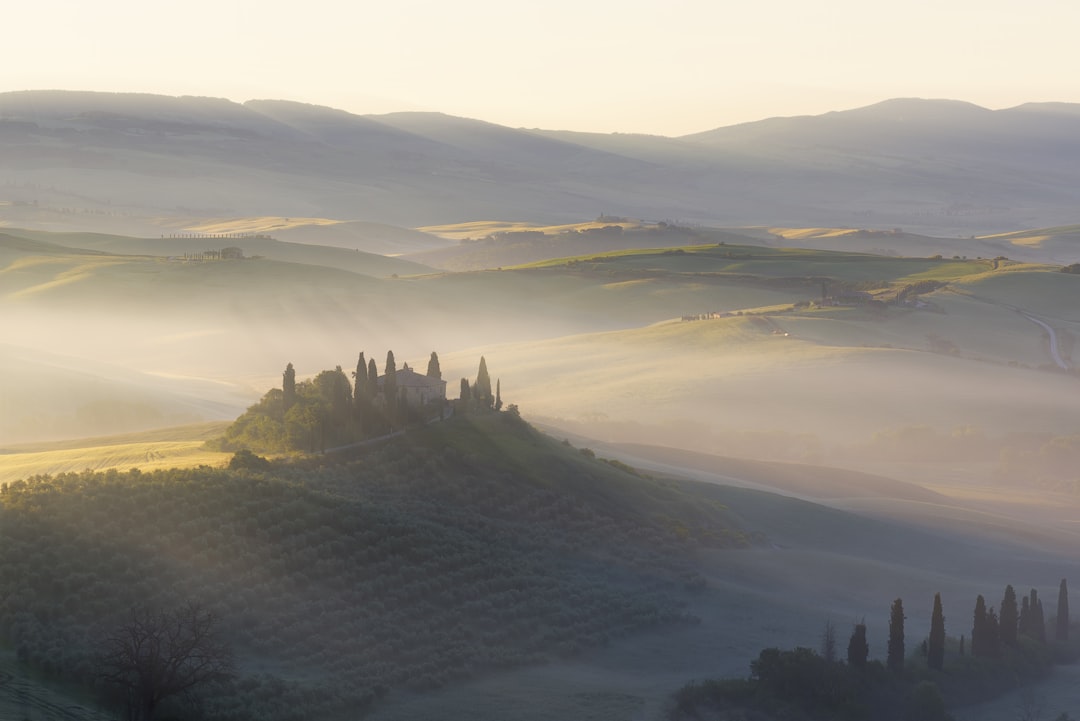
In 2013 UNESCO inscribed twelve Medici villas and two Medici gardens as a single World Heritage property. Per the Italian Ministry of Culture, the citation describes them as an 'innovative system of construction in harmony with nature,' built between the 15th and 17th centuries — a network, not a set of isolated monuments. The official Tuscan network site documents the same fourteen sites as a coordinated landscape.
What the UNESCO file makes legible is that the Medici villa was never a style. It was a climate instrument. The earliest of the inscribed properties, the Villa Medici in Fiesole, was built between 1451 and 1457 for Giovanni di Cosimo de' Medici — attributed to Alberti with Rossellino and Manetti — and is described by the Tuscan network as 'the first example where the idea of a country residence dissolves from the radical concept of fortress and castle.' A few decades later, Lorenzo the Magnificent commissioned Giuliano da Sangallo's Villa of Poggio a Caiano, c. 1485 — Vitruvian classicism translated into the rural Tuscan hillside. At the Villa of Castello, Cosimo I brought in Tribolo to design the hydraulic system and the iconographic garden program. Water, shade, orientation, thermal mass: the brief was climatic before it was ever aesthetic.
Same climate, different continent
The 2007 Peel, Finlayson and McMahon updated Köppen-Geiger world map, published in Hydrology and Earth System Sciences, is the canonical contemporary classification. It puts central Tuscany and coastal Southern California in the same cell: Csa, hot-summer Mediterranean — dry summers, mild wet winters, long shoulder seasons. The 2024 MDPI Climate study, built on a 14-model CMIP6 ensemble against WorldClim baselines, projects west-coast US wine regions drifting further toward Csa and BWh under SSP warming scenarios. Coastal California is not becoming Tuscany by analogy; it is converging onto the same Köppen class.
James S. Ackerman saw this long before the climatologists did. His Mellon Lectures, published as The Villa: Form and Ideology of Country Houses, frame the villa as a 2,000-year continuous type linking the urban patron to rural climate and landscape. The Medici inscribing themselves into that type was not nostalgia — it was climate engineering using the best available technology of their century.
Csa is also a fire climate — on both coasts
The same Csa classification that gave Tuscany its vineyards and Los Angeles its hillsides also gives both regions a structural fire problem. The 2024 Geoforum firescape study by Chastain and Islar reframes Tuscan fire risk as political-ecological rather than purely meteorological: industrialization, agrarian abandonment and the loss of traditional land management have compounded the baseline Csa fire regime. The EU's wider Mediterranean fire record, and Italian prescribed-burning research by Ascoli and Bovio, describe the same trajectory.
In January 2025, Los Angeles received the American version of that memo. Per CalMatters' January 2026 reporting, more than 2,600 residential permits have been issued against roughly 13,000 homes destroyed in the Palisades and Eaton fires — with the city compressing planning approvals that would previously have taken three months into three days. The benchmark in the same piece is Paradise, California, which after 2018 has rebuilt less than 20 percent of what was lost. LA is moving faster. The question is what it is rebuilding.
What the rebuild actually needs
The NIST answer is older than the fire. In NIST Technical Note 1794, Manzello's 2013 experimental study, flat terracotta tile outperformed other tile types under 9 m/s wind and 10 g/m²·s firebrand flux: the interlocking geometry trapped firebrands before they could reach the underlayment. Terracotta is the material that has covered Tuscan roofs for five centuries. It turns out to be, in a controlled firebrand-shower chamber, the best-performing option available to a Palisades rebuild.
The architectural answer is already being prototyped. In an April 2026 Q&A with SPF:a's Zoltan Pali, the firm describes its 2,510-square-foot Anoka House — a fire-resistant prototype developed specifically for the Pacific Palisades rebuild. Pali's move is not a historicist gesture; it is the same logic a Tuscan quattrocento architect would have recognized. Compact plan, non-combustible envelope, deep eaves, shaded openings, thermal mass at the wall, vegetation held back from the structure.
The transfer is practical, not poetic
Read in sequence, the evidence is a design brief. UNESCO documents the Medici villa as a coordinated climate system for Csa. The 2007 Köppen-Geiger map and the 2024 MDPI projection put coastal Los Angeles in that same class, drifting further toward it. The Geoforum study confirms that Csa is a fire climate on both coasts. NIST 1794 confirms that terracotta — the Medici roof — is the tile best-suited to the firebrand shower that defines a Santa Ana event. CalMatters confirms that 13,000 homes are about to be rebuilt in that climate, at speed.
The villa, in this reading, is not a style to be imported. It is a climate instrument that has simply moved west. The Medici built it out of pietra serena, lime mortar, fired terracotta and Tribolo's water. The Palisades version will be built in reinforced concrete, with climate engineering calibrated by Transsolar and structural work by DGU — the same firms already building at that standard in Venice, Fort Worth, Abu Dhabi and Baja. The typology is continuous. What changes is the shoreline.