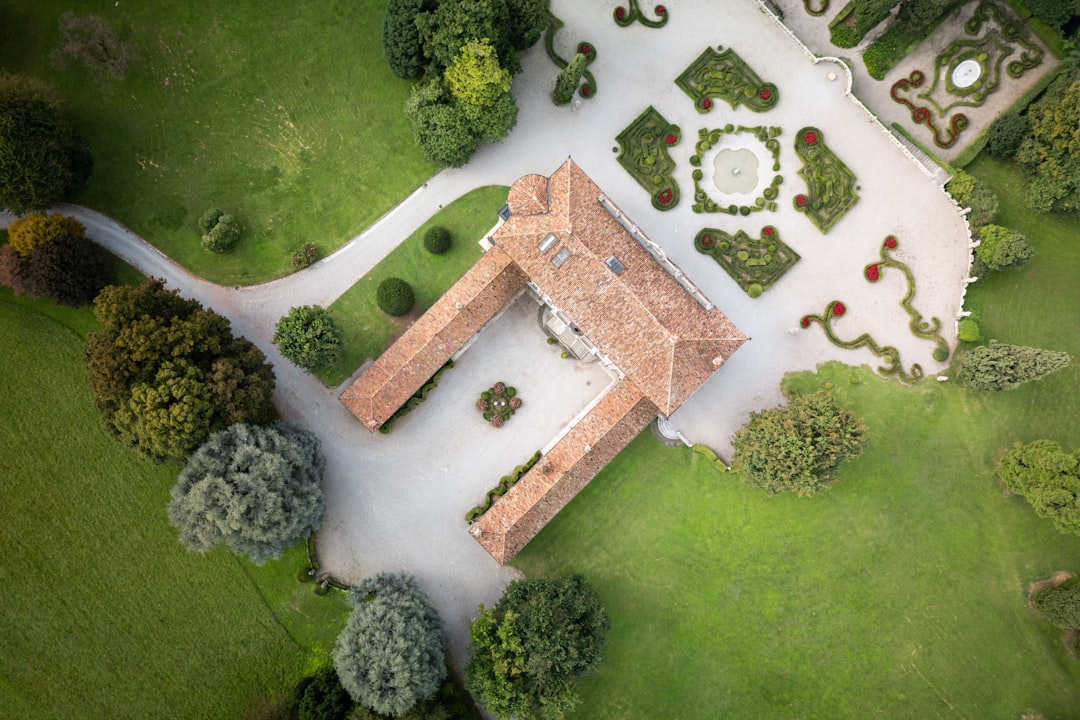
The plan of a Roman house — atrium at the front, peristyle garden at the back, both organized around a square of open sky — is one of the oldest domestic diagrams in Western architecture. The Met's Heilbrunn Timeline describes it precisely: the atrium as a shaded walkway around a central impluvium, the peristyle as an open-air courtyard garden. A house built around a void.
Two thousand years later, that same void is the thing an IBHS inspector is looking for when they walk the first five feet around a California home. The question we want to take seriously is whether those two facts are related — and what it means, in 2026, to build a house where they are the same detail.
A 2,000-year typology, not a style
James Ackerman's Mellon Lectures — published by Princeton University Press as The Villa: Form and Ideology of Country Houses — argued that the villa is a continuous Western architectural type, not a historical moment. The Renaissance did not invent the courtyard villa; it inherited the Roman plan and re-read it. The Villa Medici on Rome's Pincio Hill, acquired by Cardinal Ferdinando de' Medici in 1576 and today the seat of the French Academy, is a canonical cortile-and-garden villa at working scale — seven hectares of gardens hinged onto a walled court. A generation earlier, Villa Giulia, built by Vignola, Vasari and Ammannati for Julius III between 1551 and 1553 and now the national Etruscan museum, compressed the same logic into a Mannerist courtyard-and-nymphaeum sequence at the edge of Rome.
In 1982, the same typology was catalogued in Los Angeles. Stefanos Polyzoides, Roger Sherwood and James Tice's Courtyard Housing in Los Angeles, published by UC Press, remains the foundational typological analysis of the courtyard house in Southern California — a book that treated the form as local vernacular, not imported ornament. The line from Pompeii to the Medici to 1920s Los Angeles is, on the evidence, a single line.
Why a courtyard works in a Csa climate
Los Angeles shares a Köppen Csa hot-summer Mediterranean climate with much of the Italian peninsula. A 2025 paper in Scientific Reports — Aloshan and Aldali's parametric study — ran roughly twenty-nine thousand simulations on courtyard-villa geometries in hot-climate cities and found that compact courtyards, combined with low window-to-wall ratios, external insulation and high-performance glazing, drive cooling demand below 75 kWh per square metre per year. The earlier Solar Energy paper by Berkovic, Yezioro and Bitan had already shown, through ENVI-met modeling, that shading is the most effective lever for courtyard thermal comfort in hot-arid summer conditions, with galleries and trees adding further improvements.
None of that is news to the Roman plan. The atrium is shaded by design; the peristyle is a garden with a colonnade around it. The simulations are confirming, numerically, what the typology encodes geometrically.
Why the same plan is also a fire perimeter
The IBHS Wildfire Prepared Home Standard, updated in June 2025, is explicit about the 0-to-5-foot noncombustible zone around the structure — Zone 0 — as essential for halting ember and flame ignition. IBHS's December 2025 field study of the Palisades and Eaton fires, drawing on 250-plus properties assessed between January 13 and 19, 2025, put hard numbers on what that perimeter is worth. Homes with four hardening features survived at 54 percent; homes with only one survived at 36 percent. Homes whose Zone 0 was more than 25 percent combustible fuel had roughly a 90 percent risk of damage or destruction.
State policy is now following the data. LAist's reporting on the California Board of Forestry's draft Zone 0 rules frames the scale: around 17 percent of California buildings would be affected, and modeling suggests the rule could reduce structure losses by roughly 17 percent. A noncombustible five-foot ring around the house is, increasingly, the floor.
A reinforced-concrete courtyard wall — the same wall that encloses the cortile in a Medici or a Giulia plan — is that ring by default. It is not a retrofit. It is not a landscape material. It is the structure.
One detail, three briefs
Read together, the Met's Roman-housing essay, Ackerman's two-thousand-year villa type, Polyzoides' 1982 LA catalogue, the Scientific Reports simulations, and the IBHS Palisades/Eaton study point at a single detail doing three jobs. The wall that makes the courtyard is also the thermal mass that drives cooling demand below 75 kWh per square metre per year, and also the noncombustible Zone 0 perimeter the 2025 IBHS standard requires and the 2026 California rule will codify.
For a 2026 Palisades rebuild, that is not a metaphor. It is a construction specification: one envelope, one material, three regulatory and climatic frameworks satisfied at once. The courtyard, after two millennia, is the most efficient fire-safe floor plan California has available.