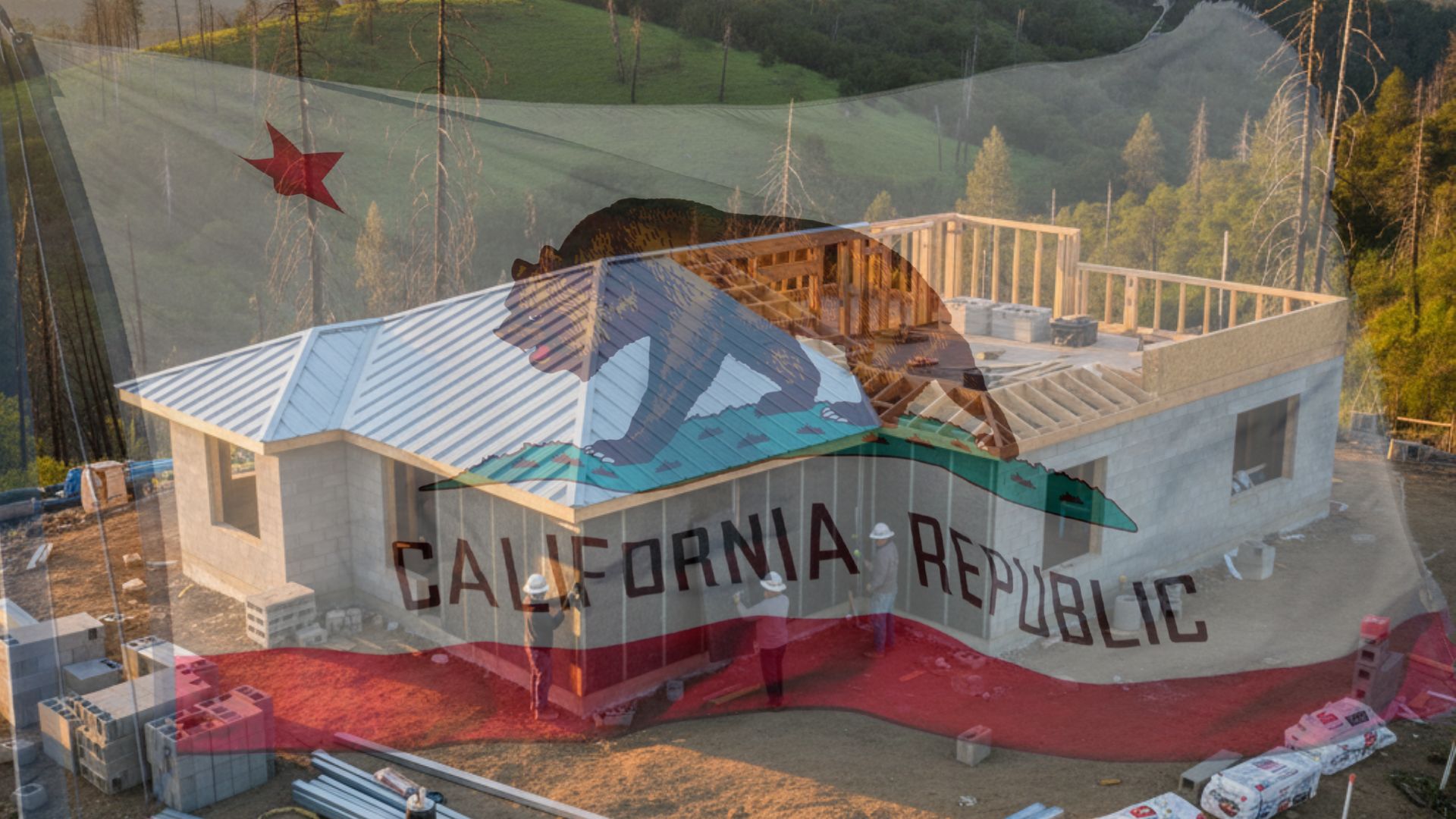
A new analysis published by Live Insurance News argues that Los Angeles homeowners rebuilding after the January 2025 wildfires face a counterintuitive piece of math: specifying a fire-resistant construction package adds roughly 3% to total rebuild cost, while potentially reducing annual insurance premiums by a multiple of that figure over the life of the home.
The framing is provocative — an 800% return, expressed in insurance terms — but the underlying logic reflects a structural shift in how California's residential market is being underwritten. Material choice, once a question of aesthetics and cost-per-square-foot, has become a financial variable.
The numbers behind the headline
The 3% figure refers to the marginal cost of upgrading a conventional wood-frame rebuild to a specification that meets the IBHS Wildfire Prepared Home standard — Class A roofing, ember-resistant vents, non-combustible siding, defensible-space landscaping, and tempered or multi-pane glazing. These are not exotic upgrades; they are increasingly the baseline for any home seeking traditional insurance coverage in a Fire Hazard Severity Zone.
Estimated cost premium for fire-resistant rebuild
Wildfire premium discount for IBHS-certified homes
Mitigation measures under Safer from Wildfires
On the insurance side, the California Department of Insurance's Safer from Wildfires regulation requires every admitted carrier to offer discounts to homeowners who adopt 12 specific mitigation measures — from a 5-foot non-combustible perimeter to enclosed eaves and upgraded vents. Carriers including Mercury, USAA, Travelers and Chubb now reference IBHS designations directly in their underwriting models, with reported wildfire-portion discounts of up to 50% for fully certified homes.
Layered on top: the 2026 California Wildland-Urban Interface (WUI) Code, mandatory from January 1, 2026 for new builds in designated zones. For most rebuilds in Pacific Palisades, Altadena, Malibu, and Topanga, the choice is no longer whether to build to a higher standard, but how far past the minimum to go.
What this actually means in LA
The 3% headline is directionally correct but obscures a more interesting reality. The cost differential narrows — and sometimes inverts — once you account for which construction systems natively comply versus which require expensive retrofitting of fundamentally combustible assemblies. A wood-frame home with cementitious cladding, ignition-resistant vents, and a Class A roof is still a wood-frame home; the structural envelope remains combustible.
Reinforced concrete and ICF (insulated concrete form) systems, by contrast, satisfy most WUI structural requirements as a condition of the system itself — a shift we examined in more detail in our piece on concrete homes in Los Angeles under the 2026 WUI Code. The compliance work is largely already done at the structural design stage. For homeowners weighing rebuilds in the $5–15M range — common in the affected ZIP codes — the marginal cost question reframes around lifecycle economics: insurance, maintenance, and the option value of insurability itself in a market where carriers continue to non-renew at scale.
The 3% figure is most useful, in other words, as an entry point into a longer conversation. The real question is not what fire-resistance costs, but what conventional construction now costs in foregone insurability and depreciating asset value.
The trajectory
The 2025 fires accelerated a transition that was already underway. Insurance, building code, and capital markets are converging on a single signal: structural resilience is now a measurable financial attribute — a point we developed in our analysis of why construction material now decides your California fire insurance premium. The rebuild decisions being made across Los Angeles in 2026 will define the city's residential risk profile for the next half-century — one specification at a time.