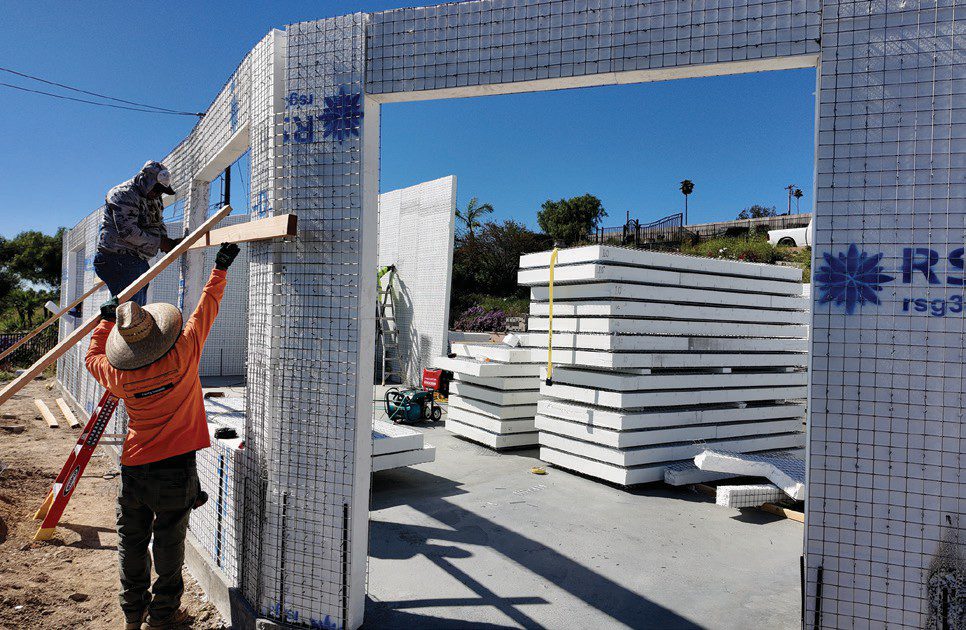
The Camarillo Acorn published a detailed look this month at how concrete construction methods are moving from the specialist fringe toward the center of Southern California's rebuilding strategy. The piece, "Concrete innovations on the road to fire rebuilding," documents how homeowners and builders across the region are re-evaluating materials in the aftermath of the January 2025 fires — examining insulated concrete forms, precast panels, and hybrid concrete assemblies as viable alternatives to conventional wood-frame reconstruction.
It is a small but telling shift. Regional papers have long treated concrete as an exotic outlier. Treating it as a practical choice — one with measurable fire performance, insurance implications, and long-term cost logic — marks a different moment in the LA rebuild.
The data behind the shift
The January 2025 Palisades and Eaton fires destroyed more than 16,000 structures combined, according to CAL FIRE's 2025 incident archive. Nearly all were wood-frame. The reconstruction question is no longer whether to harden — it is how far the hardening should go, and at what level of the assembly.
Research from the Insurance Institute for Business & Home Safety has consistently identified two failure modes as dominant in WUI losses: ember intrusion through vents and openings, and ignition of combustible cladding or eaves under radiant heat. Both are material problems before they are design problems. A reinforced concrete envelope eliminates the cladding ignition pathway entirely and reduces the ember-intrusion surface to windows and mechanical penetrations — a smaller, more manageable detailing problem.
Regulatory alignment is accelerating the move. The California Wildland-Urban Interface Code (Title 24, Part 7) becomes mandatory for all new construction in Fire Hazard Severity Zones on January 1, 2026. Its requirements for non-combustible exterior walls, Class A roofs, and ember-resistant vents are substantially easier — and cheaper — to meet with a concrete structural system than by retrofitting compliance onto a wood frame.
Reinforced concrete walls achieve a fire rating of 4+ hours. The same assembly can natively satisfy all 12 measures of California's Safer from Wildfires framework and the 2026 WUI Code — three compliance frameworks in a single structural choice.
What it means for the LA market
The Camarillo Acorn's framing matters because it is regional, not national. When a local paper covering Ventura County treats ICF and precast as practical options for homeowners — not as avant-garde experiments — the information environment has shifted. Contractors get asked different questions. Appraisers see different comparables. Insurers field different applications.
For the high end of the LA market, the implication is sharper. A luxury rebuild in Pacific Palisades, Malibu, or Altadena is now being underwritten against a 30-year horizon in which the insurability of wood-frame construction is an open question. Concrete is not a stylistic decision in that context — it is a structural hedge against regulatory drift, carrier withdrawal, and the material risk of rebuilding twice. We examined the pricing mechanics in our note on why construction material decides your California fire insurance premium. The coverage in smaller regional outlets suggests that this calculus is beginning to move downstream from architects and underwriters into the conversations homeowners are actually having.
Material, not accessories, is the variable that compounds over decades.
What comes next
The coming months will test whether the concrete conversation survives the pressure of rebuild economics — where speed, cost, and contractor availability pull hard toward familiar methods. The 2026 WUI Code deadline will force part of the answer. Insurance market behavior will force the rest. What is already clear is that the structural material of an LA home is no longer a back-of-house specification. It is the first decision, and it shapes every other one — a dynamic we quantified in our breakdown of fire-resistant home construction cost in California and the insurance savings it unlocks.