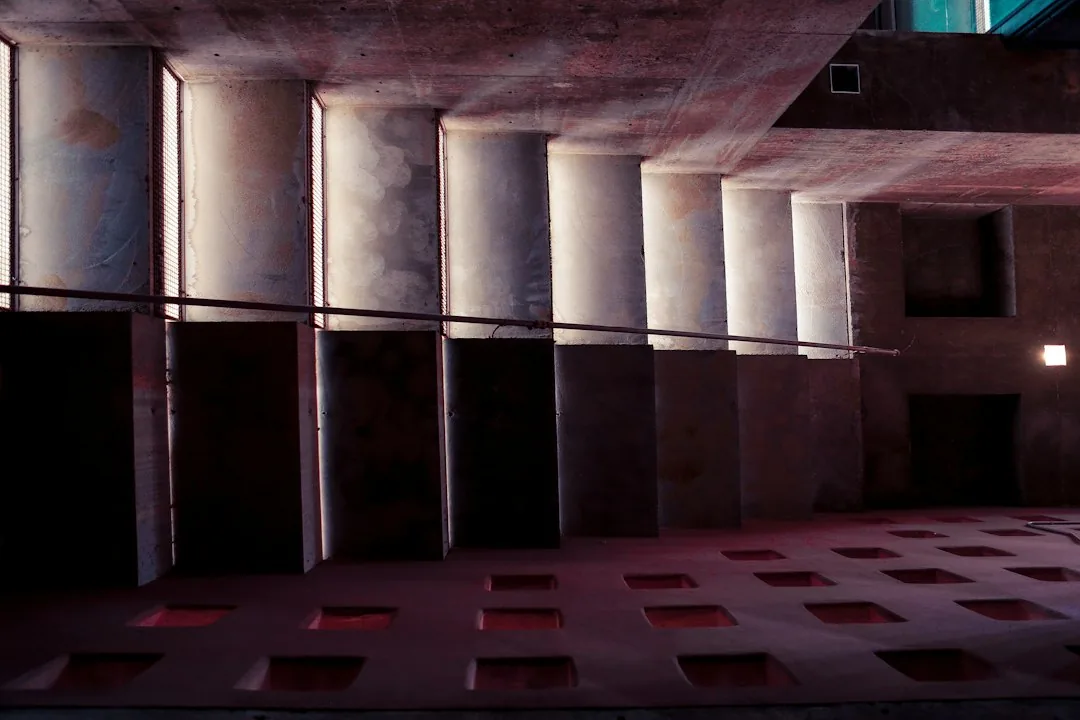
Wonderful Museums has published a long-form feature on Benesse House on Naoshima Island, the building where Tadao Ando collapsed two typologies — art museum and hotel — into a single work of concrete. The piece describes Ando, the self-taught architect, as creating spaces that evoke contemplation and serenity, aligned with founder Soichiro Fukutake's ambition to bind art, architecture and nature into one continuous experience on a small island in the Seto Inland Sea.
It is worth reading as a design document rather than a travel piece. Benesse House is the rare building where guests sleep inside the museum, which means the architecture had to survive a test most concrete buildings never face: waking up in it, every morning, for days.
Source: Wonderful Museums — Benesse House Museum Hotel, Naoshima
One material, three jobs
The discipline of the building is that almost nothing is added. In-situ reinforced concrete is structure, envelope and finish simultaneously — poured once, and then left alone. There is no stud cavity, no weather barrier, no furring, no plaster coat, no paint cycle. What you touch is what holds the roof up.
This is the part most clients underestimate. Building this way does not remove cost; it relocates it. Money that a conventional luxury house spends on layered wall assemblies and finish trades migrates upstream into formwork, reinforcement detailing, mix design and pour sequencing. The surface has no second chance. Ando's work became the international benchmark for that standard — recognised with the Pritzker Prize in 1995, awarded for a body of work built almost entirely from cast concrete.
Source: The Pritzker Architecture Prize — Tadao Ando, 1995 Laureate
1992 — Benesse House opens on Naoshima, combining museum and hotel in one structure (Wonderful Museums)
1995 — Ando receives the Pritzker Prize (Pritzker Architecture Prize)
3-in-1 — structure, envelope and finish delivered in a single operation
The grid nobody notices
The quiet intelligence of Ando's concrete is that it is proportioned. The formwork panel sets a module; the tie-holes mark its corners; every wall reads as a field of repeating rectangles at a scale close to the human body. It is the same ordering instinct as a Palladian bay or a Roman coffered vault — a unit of measure that lets a large surface stay legible. Strip that discipline away and exposed concrete becomes what its detractors accuse it of being: a blank, unresolved plane.
Concrete is not a mood. It is a grid, a tone and a light condition — and all three are decided on paper, before anything is poured.
What this means for Los Angeles
Southern California has a long, unfinished argument with exposed concrete in the home. The prevailing assumption in the luxury market is that the material belongs in galleries, wine rooms and retaining walls, and that living spaces require timber, plaster and stone to feel habitable. Benesse House is a thirty-year refutation of that, run under the hardest possible conditions — paying guests, humidity, salt air, continuous occupation.
The transferable lessons are specific. First, thermal mass behaves beautifully in a Mediterranean climate: heavy walls damp the daily temperature swing that defines the LA basin and the coast, reducing mechanical load rather than fighting it. Second, a single-material envelope removes the interfaces where conventional assemblies age badly — the joints between cladding, membrane and framing that fail on their own separate schedules. Third, non-combustibility arrives as a by-product of a design decision rather than as a bolt-on package; the wall that orders the room is also the wall that does not burn.
The real constraint in California is not aesthetic acceptance. It is execution capacity. Fair-faced concrete at hospitality standard requires a contractor who treats formwork as joinery and a design team willing to resolve every penetration, reveal and tie-hole before the first truck arrives. That skill set is scarce here, and it is the difference between a wall people run their hand along and a wall somebody eventually decides to paint.
The next decade
Expect the boundary between hospitality and residential concrete to keep dissolving. Clients who have stayed in Naoshima, in Venice, in the new generation of concrete resorts now ask for that surface quality at home — and the underwriting climate in California happens to reward the same choice for entirely unrelated reasons. Two arguments, one wall. That convergence is what will move exposed concrete from specialist taste to mainstream expectation in the Californian luxury house.