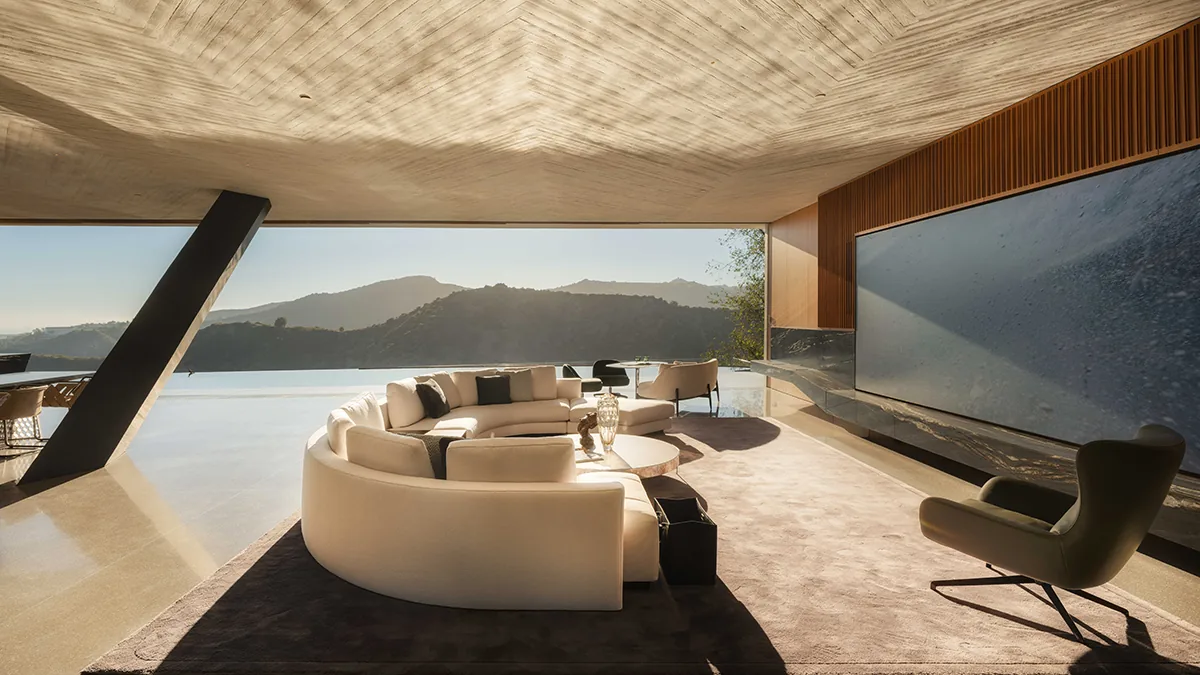
A $36.5 million Brutalist mansion on Bel Air's Linda Flora Drive shows what reinforced concrete delivers at the top of the market: nearly 11,000 square feet anchored by 10 million pounds of concrete, according to Robb Report, producing a single continuous material language of columns, terrazzo, and structure read as finish.
Robb Report has listed a $36.5 million Brutalist mansion at 1331 Linda Flora Drive in Bel Air, and the number that matters sits underneath everything else: roughly ten million pounds of reinforced concrete. The nearly 11,000-square-foot house, set on over half an acre with two pools and ocean views, pairs angled concrete columns with polished terrazzo floors and rich wood paneling to produce what its press materials call a “continuous material language.” That phrase is doing real work, and it is worth taking seriously on its own terms.
What does ten million pounds of reinforced concrete actually buy?
It buys the right to treat structure as finish. When concrete carries the loads and also forms the visible surface, there is no secondary cladding to detail, caulk, weather, or eventually tear off. The angled columns are not decoration applied to a frame; they are the frame, which is why the interiors can read as one material rather than a stack of assemblies.
That mass also does quiet architectural work: thermal stability, acoustic calm, and a datum of permanence that lightweight construction cannot imitate. Per Robb Report, the specifications line up as follows.
| Metric | Value | Source |
|---|---|---|
| Asking price | $36.5 million | Robb Report |
| Interior area | ~11,000 sq ft | Robb Report |
| Reinforced concrete | ~10 million lbs | Robb Report |
| Swimming pools | 2 | Robb Report |
| Site | Over half an acre | Robb Report |
Why is Brutalism returning to the Los Angeles luxury market?
Because the aesthetic and the engineering now point the same direction. For a generation, exposed concrete at this scale read as institutional—museums, libraries, the Kimbell. In fire-exposed Los Angeles, the same non-combustible mass that reads as monumental also reads as durable, and buyers at the top of the Westside market have started to prize both qualities at once.
The craft discipline is what separates a serious concrete house from a heavy one. Angled columns, board-formed or fair-faced surfaces, and polished terrazzo demand that the formwork, the pour sequence, and the aggregate be resolved as design decisions, not site improvisations. Get it right and the terrazzo, the structure, and the paneling belong to a single palette. Get it wrong and the mass just sits there.
What the Linda Flora listing signals, for the broader LA market, is that reinforced concrete has crossed from a performance argument into a design argument. The house is not being sold on its fire rating; it is being sold on its material language. That is the more durable form of demand. When a Bel Air buyer pays a premium for exposed structure, the mass they are paying for happens to be the same assembly that underwriters now reward and that outlives the finishes stapled onto a conventional luxury build. Design intent and engineering logic are, for once, aligned on the same page—and in a market where lightweight spec homes still dominate, a continuous concrete language is a genuine point of differentiation rather than a styling choice.
The next cycle of high-end Los Angeles construction will likely be decided less by square footage and more by what the square footage is made of. A house that treats its structure as its finish ages differently than one that hides it—and in the Westside's luxury tier, permanence is quietly becoming the thing buyers are willing to pay to see.