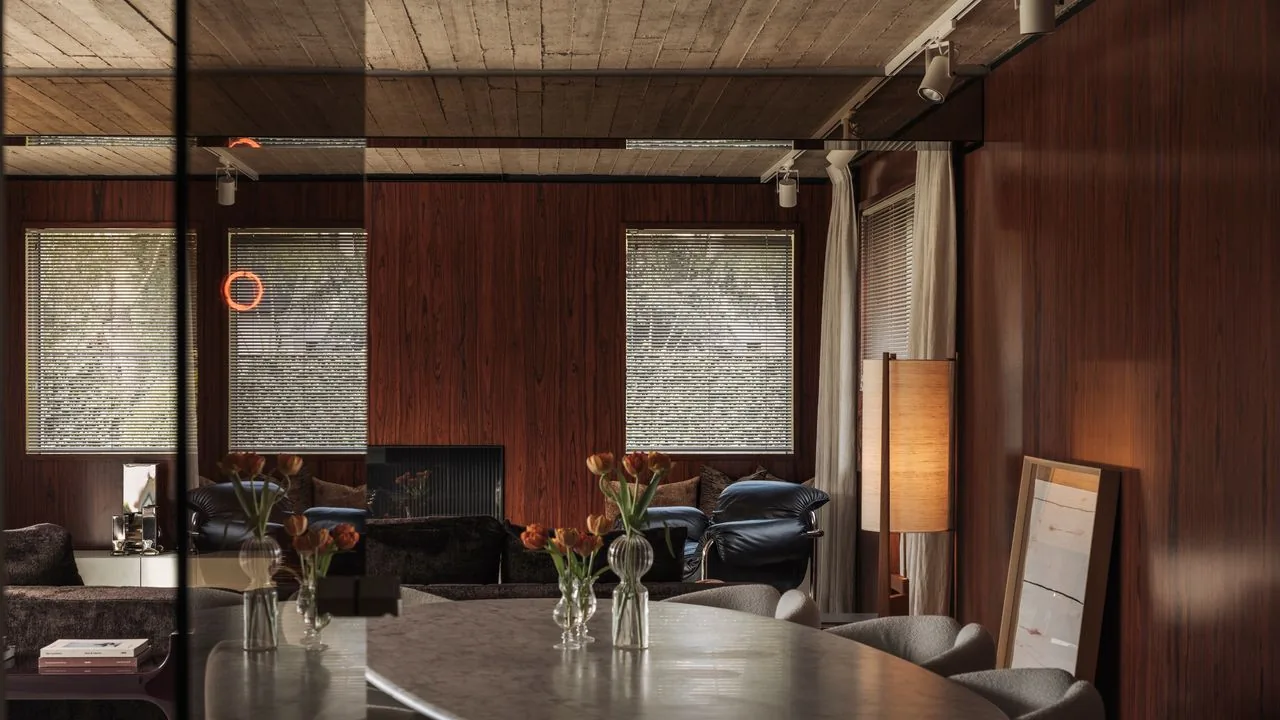
A 1970s Belgian villa profiled by AD Middle East shows raw concrete need not read as cold: béton brut walls are warmed by leather, velvet and smoked glass, and a sculptural outdoor shower is cast in situ as a single object. The lesson — concrete is a finish to design, not just a structure to hide.
AD Middle East has profiled a 1970s Belgian villa that treats raw concrete as the entire vocabulary of a home — structure, surface and sculpture at once. The house sets béton brut walls against leather, velvet and smoked glass, and its most photographed gesture is a sculptural outdoor shower cast in situ: concrete poured in place and left to read as a single continuous object. Four decades on, it is a reminder that concrete was once the most expressive material in domestic architecture — and that, for the people who built with it, its warmth was never in doubt.
Why doesn't this concrete villa feel cold?
Because the concrete here is a backdrop for touch, not an end in itself. According to AD Middle East, the villa sets béton brut against leather, velvet and smoked glass — soft, light-absorbing materials that borrow the concrete's gravity while cancelling any chill. The cast-in-situ shower proves the logic in reverse: left bare and shaped with care, concrete stops being a wall and becomes sculpture.
A 1970s house, a raw-concrete shell, and three deliberate material pairings — the whole case for concrete as a finish, made in one villa.
| Element | Material pairing | Effect |
|---|---|---|
| Primary walls | Béton brut + leather | Warmth and grain against mass |
| Upholstery | Velvet | Absorbs and softens light |
| Glazing | Smoked glass | Dims and filters the interior |
| Outdoor shower | Cast-in-situ concrete | Reads as a single sculptural object |
What the villa documents is a discipline that much contemporary luxury construction has lost: concrete specified for how it would look and feel, not merely for how it would carry load. The formwork is part of the design. The tone is part of the design. The adjacency to a hide, a weave, a pane of grey glass is part of the design.
What can California luxury homes learn from béton brut?
That concrete belongs in the room, not hidden behind it. In a market where fire-exposed Los Angeles neighbourhoods are quietly shifting toward non-combustible structure, the easy mistake is to treat concrete as an engineering concession — poured, then plastered and clad until it disappears. The Belgian villa argues the opposite, and it argues it on purely aesthetic grounds.
For a Westside or Malibu commission, the implications are concrete in both senses. A reinforced-concrete envelope can be left fair-faced, toned warm, and set against the Mediterranean palette California already loves — olive wood, limewash, woven textiles, stone. Owners spend fortunes cladding resilient structures in combustible finishes to soften them; the smarter move is to design the concrete to be the finish. The 1970s got there first, with leather and velvet and a shower you would want to stand in.
- Specify concrete tone and formwork texture as finish decisions, not afterthoughts.
- Pair raw surfaces with warm, light-absorbing materials — leather, velvet, timber, linen.
- Use smoked or tinted glazing to control interior light against the concrete's grey.
Concrete has spent fifty years being mischaracterised as the cold option. A single Belgian house, leather-lined and cast with intent, is enough to retire the cliché — and to suggest that the most durable surface in the home can also be its most sensual. The question for California's next generation of villas is not whether to build in concrete, but whether to have the nerve to leave it showing.