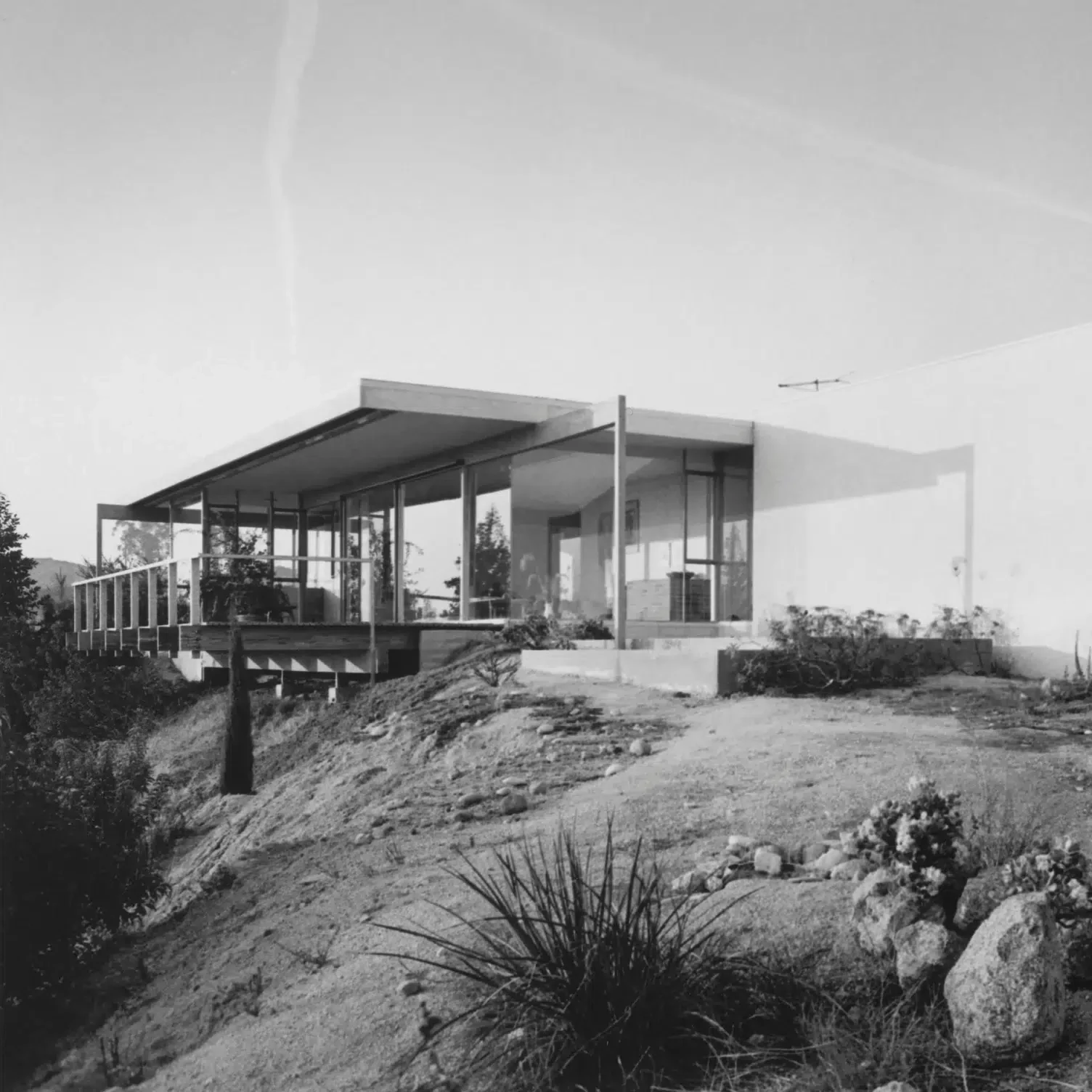
Frederic Magazine has published a profile of Los Angeles designer Jaime Rummerfield and her long campaign to keep the city's significant houses standing. More than a decade ago, Rummerfield and her then design partner Ron Woodson began noticing that houses by architects including Wallace Neff and Paul R. Williams were being demolished by owners who wanted something bigger and newer — and that very little landmark protection existed to stop it, according to Frederic Magazine. The detail worth sitting with is who was doing the demolishing. Not assemblers of parcels, not distressed sellers: private owners of intact, well-built, architect-designed houses in the best neighborhoods in the city.
Source: Frederic Magazine, August 2026.
The teardown is a design verdict
Los Angeles protects institutions far better than it protects houses. A privately owned residence, however distinguished its authorship, is generally a demolition permit away from a vacant lot unless someone intervenes — which is precisely the gap Rummerfield's advocacy work exists to fill (Frederic Magazine). But regulation is downstream of a more uncomfortable fact. When an owner with the means to restore a Neff instead pays to remove it, the building has failed a test that has nothing to do with beauty. It has failed to be worth adapting.
10+ years — length of the Los Angeles preservation campaign profiled by Frederic Magazine.
Two architects — Wallace Neff and Paul R. Williams, both cited as losing built work to owner-initiated teardowns.
Look at what those houses actually are. Neff's Mediterranean and Spanish Colonial Revival work is built with thick, load-bearing perimeter walls, deep-set openings, generous wall-to-window ratios and tile roofs — an architecture of mass, shade and reveal, calibrated to a dry climate long before anyone called that passive design. Williams worked with a different instrument: proportion, sequence and an almost cinematic control of arrival, wrapped around plans of unusual social intelligence. Neither is fragile. Neither is worn out. What dates them is square footage, ceiling height in the service zones, and the assumption that mechanical systems, kitchens and bathrooms would stay roughly where the original drawings put them.
Why adaptation loses the math
A house gets demolished when the cost of changing it approaches the cost of replacing it. In a 1930s masonry house, moving a wall means engineering; adding a subterranean garage means underpinning; running contemporary services means chasing solid walls or dropping ceilings that were the point of the room. The owner is then told that a new build gets more floor area, faster permitting and cleaner insurance underwriting for a similar number. That comparison, not indifference to Neff, is what kills these houses.
A building is erased at the moment adaptation costs more than replacement — and that moment is set by the original structural logic, not by taste.
The lesson for anyone commissioning new work in Beverly Hills, Malibu or Bel Air today is uncomfortable, because the current generation of luxury houses is far more disposable than the ones being torn down. A steel-and-stud house with a bespoke facade assembly, integrated millwork and a plan tailored to one family's habits has a structural life of a century and a functional life of perhaps twenty-five years. The Neff houses at least offered mass, permanence and a room-based plan that could absorb new uses. Much of what replaces them offers neither longevity of fabric nor flexibility of layout — only a larger number on the appraisal, which is exactly the metric that will be used against them in 2060.
Designing for a second life
Preservation advocacy of the kind Frederic documents is necessary, and its value in Los Angeles is real. But the durable fix is upstream. Buildings that survive tend to share a small number of traits: a structure independent of the partitions, rooms proportioned generously enough to be reassigned, services grouped in accessible zones rather than buried, and an envelope that does not need replacing every twenty years to keep working. Those are decisions made in schematic design, at almost no premium, by architects who assume their client will not be the last person to live there.
The houses Los Angeles will fight to keep in fifty years are being drawn now. Whether they are worth the fight will be decided less by their style than by whether their structure allows a future owner to say yes to change without reaching for a demolition permit.