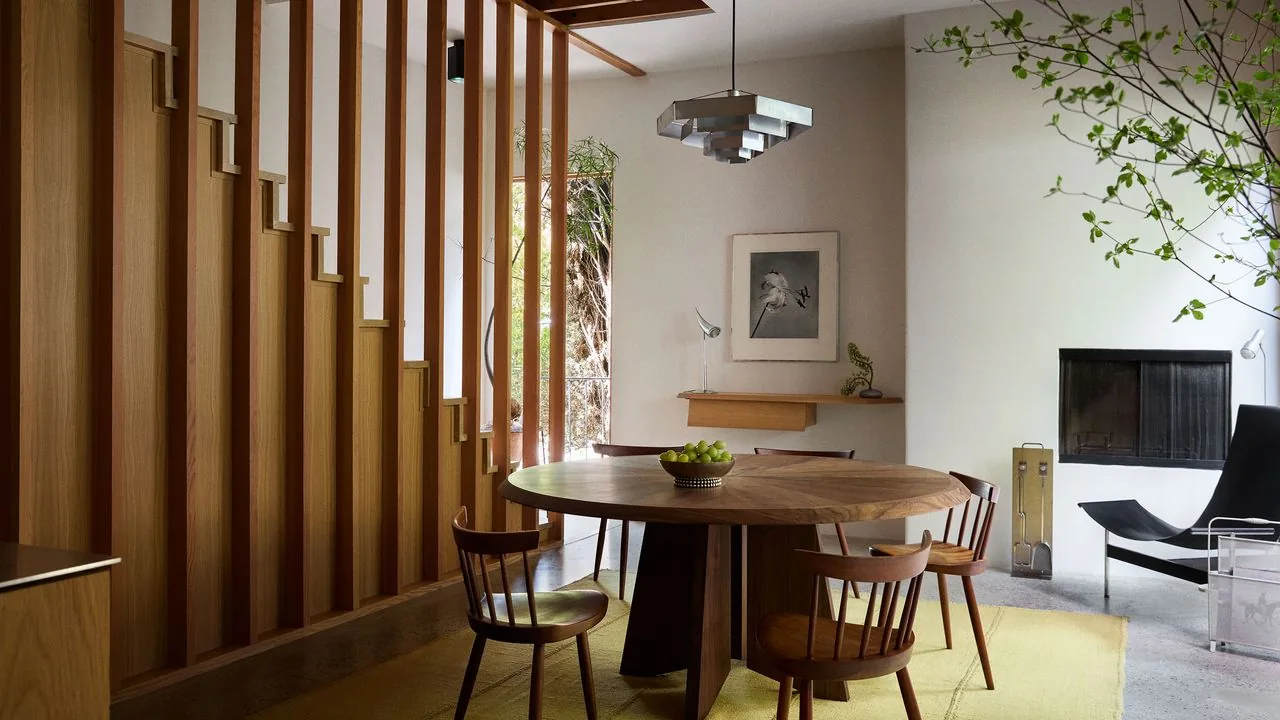
Designer Dean Levin transformed a 'no-style' Los Angeles house into an homage to the city's architecture by organizing it around a single motif — layering — introduced via a Bruno Munari pendant, according to Architectural Digest's October 2026 feature. The approach prizes design coherence and material over borrowed historical style.
Architectural Digest has published a feature on designer Dean Levin, founder of the Los Angeles studio 22RE, who turned what the magazine calls a "no-style" house into an ode to the city's iconic architecture and design. The October 2026 story, written by Leonora Epstein with photography by Stephen Kent Johnson, reads less as a renovation and more as an argument: that Los Angeles has a design language worth speaking fluently.
Levin anchors the house around a single idea — layering. In his telling, it begins with a Bruno Munari pendant, chosen for its dynamic, overlapping planes, and is then carried deliberately through the rest of the rooms. The result is a home built from a theme rather than a trend.
What makes Dean Levin's LA home an ode to the city's architecture?
The home translates Los Angeles's mid-century, indoor-outdoor, light-and-material tradition into a contemporary interior organized by one consistent motif rather than a borrowed historical style. Per Architectural Digest, Levin started from a house with no identity and built coherence outward from a single design decision.
That instinct has deep local roots. R.M. Schindler's Kings Road House of 1922 pioneered tilt-slab concrete as a domestic language in LA; the Case Study House Program (1945–66) made the city a laboratory for structural clarity and glass-walled living; Julius Shulman's photographs fixed that vocabulary in the public imagination. A house that pays homage to this lineage is not quoting a style — it is adopting a discipline.
1922 — Schindler's Kings Road House, LA's first tilt-slab concrete home.
1945–66 — The Case Study House Program, LA's modernist design laboratory.
Why does layering define good Los Angeles design?
Because the best LA houses have always negotiated between interior and landscape, light and shade, mass and transparency. Layering is how a home handles a climate that invites the outside in — and it is precisely the device Levin uses to give an anonymous house a point of view.
Read with an architect's eye, the move is a question of proportion and sequence more than decoration. A pendant becomes a rule; a rule becomes a plan; a plan becomes a set of rooms that feel inevitable. That is the difference between styling a house and designing one.
- A single motif enforces discipline across every room.
- Light is treated as a material, not an afterthought.
- Interior and landscape are read as one continuous composition.
What does this mean for the Los Angeles market?
For a market saturated with square footage and spec-grade finishes, Levin's house is a useful corrective. The premium here is authorship — coherence you can feel — not a bigger kitchen island. Buyers and agents at the top of the LA market increasingly recognize that a home with a clear idea ages better than one assembled from catalogue choices.
It also points to where enduring value sits: in design intelligence paired with material that can carry it. The Case Study generation proved that a modest footprint, rigorously conceived and honestly built, can outlast far grander houses. In a city perpetually rebuilding and reinventing its stock, that lesson has never been more relevant — the homes that matter are the ones with a position, executed in materials that let the position last.