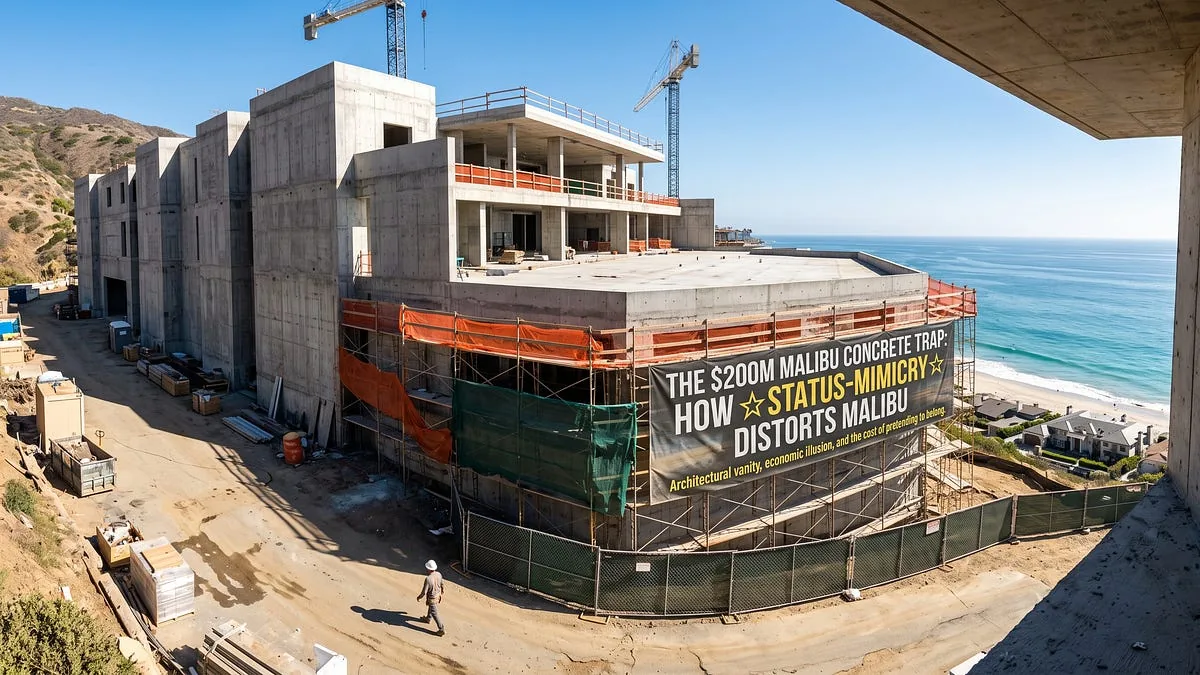
When Beyoncé and Jay-Z paid $200 million, all cash, for a Tadao Ando-designed compound above Paradise Cove, the sale set the record for the most expensive home transaction in California history. That is the starting point of a sharp essay on Mr. Malibu's Substack, which uses the deal to examine a quieter effect: how a single trophy house can recalibrate what an entire market thinks it wants. The essay's term for it is status-mimicry, the impulse to acquire the look of the most prestigious house on the coast rather than the thinking that produced it. Concrete is its most visible symptom.
Source: Mr. Malibu, “The $200M Malibu Concrete Trap: How Status-Mimicry Distorts Malibu,” mrmalibu.substack.com
What a $200 Million Wall Actually Contains
The record is the headline. The more useful figure for anyone commissioning in Malibu is much harder to quantify. An Ando wall is less a material choice than a drawing executed at full scale. Across his work, from the Church of the Light in Osaka to Punta della Dogana in Venice, the concrete is cast against formwork whose panel joints and tie holes are set out as deliberately as window openings. The grid on the finished surface is part of the composition. The surface is meant to be read up close, in raking light, and it leaves almost no room for correction: once poured, it stays.
That is precisely the part that does not travel. As the Mr. Malibu essay argues, what spreads after a record sale is the image, detached from the discipline underneath it: gray planes, flat roofs, long runs of glass. The cost of a serious architectural concrete wall sits largely in things a listing photograph never shows. Mockup panels, formwork engineering, a stable mix and pour sequences planned so that joints land where the architect wants them all carry that cost. Strip those out and what remains is a gray box, sometimes not even concrete at all, but a skim coat or cladding imitating it.
The second thing that does not travel is siting. Ando's walls are instruments for editing a landscape: they withhold the view, then release it. On a Malibu bluff, where the Pacific is the obvious subject, that restraint is the hardest design decision to make and the easiest to skip.
Reading the Malibu Market Through the Ando Effect
For Los Angeles, the risk in status-mimicry is less aesthetic than reputational. When concrete is demanded as a signifier, it tends to be specified by the people least equipped to execute it. Each poorly cast, stained or patched facade teaches buyers that the material is cold and unforgiving. The opposite is true when it is done well: few materials age with more dignity in coastal light.
A buyer drawn to the Ando reference can test whether they are commissioning a lineage or a likeness with a few direct questions:
- Who draws the formwork and tie layout, the architect or the subcontractor?
- Will a full-scale sample wall be poured and approved on site before production begins?
- Is the concrete the finished surface, or a substrate hidden behind something else?
- Does the plan earn its walls, or do the walls simply enclose a conventional house?
The answers separate a building that belongs to its ground from one that belongs to a mood board.
After the Record
Record sales leave long shadows in Malibu, and this one will shape design briefs for years. The more interesting outcome would be a market that treats the Paradise Cove house as a standard to measure against rather than a style to order. In that market, buyers would ask for fewer, better-cast walls, and architects would be asked to justify each one by what it does for the site.