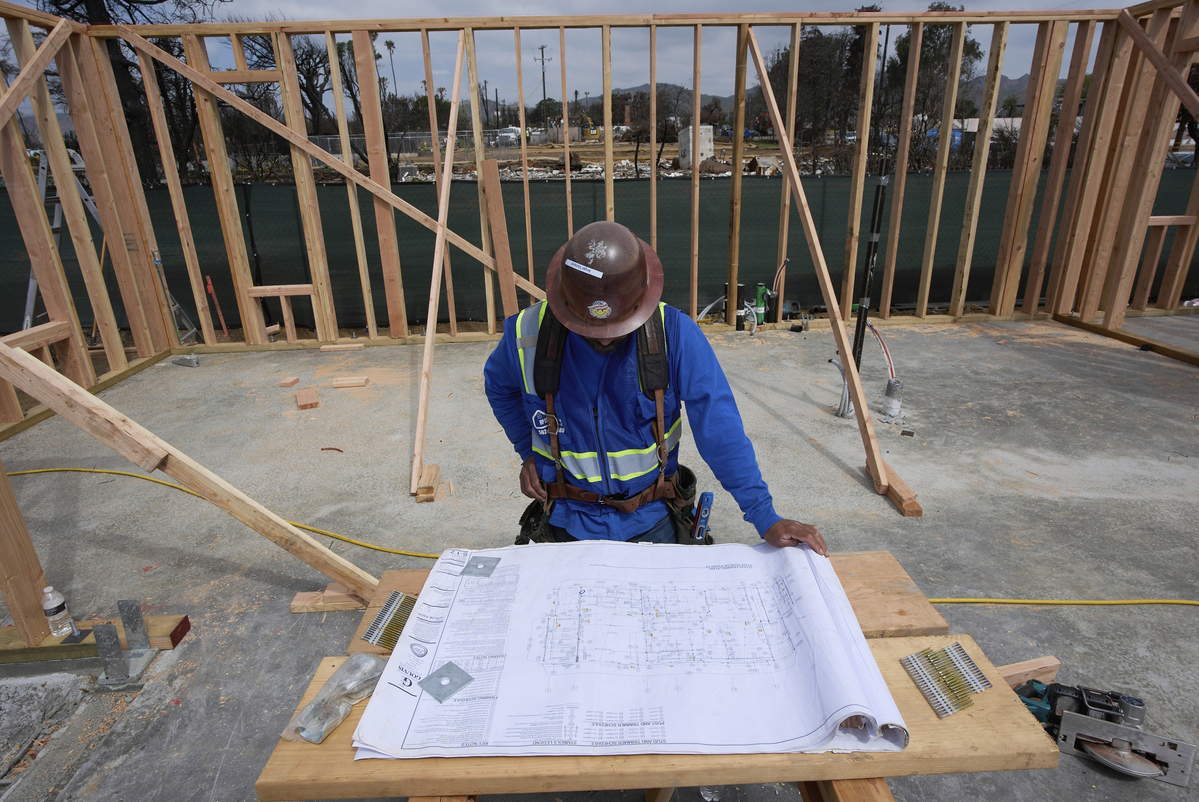
Fifteen months after the Palisades and Eaton fires destroyed roughly 9,900 homes across Los Angeles County, only 34 houses have been completed in Pacific Palisades and Altadena combined. That is the central finding of a data investigation published by POLITICO's E&E News, reported by housing correspondent Liam Dillon and data editor Sean McMinn.
The piece is not an opinion column. It is a lot-by-lot audit of permit filings, construction starts and finished homes, benchmarked against comparable Northern California recoveries. The conclusion is blunt: the pace Governor Newsom and Mayor Bass promised — a "record-time" rebuild — is not what the permit data shows on the ground.
What the data actually says
POLITICO's analysis documents three measurable gaps. First, completion: 34 finished homes across the two burn zones in 15 months. Second, pipeline: fewer than half of the roughly 9,900 destroyed lots have even a permit application on file. Third, comparison: LA's rebuild rate is trailing the pace seen after comparable Northern California wildfires at the equivalent point in their recovery cycles.POLITICO / E&E News, Dillon & McMinn, 2026.
The gap between political communication and permit reality is not uniform across the county. POLITICO notes that administrative streamlining — executive orders, fee waivers, expedited review lanes — has been announced, but the conversion from announcement to issued permit has been slower than the comparable benchmarks from the 2017 Tubbs fire recovery and the 2018 Camp fire in Paradise, both of which were documented extensively by the Los Angeles Times in its one-year retrospective on the LA fires.
What this means for the LA market
A permit backlog of this scale is not a scheduling inconvenience. It is a structural variable that changes how homeowners should think about rebuilding decisions. If the realistic window between lot-clearance and keys-in-hand is measured in years rather than months, then the calculus shifts from "how fast can I replace what I had" to "what should I build given I am only going to do this once."
Three consequences follow. First, construction material choice becomes a strategic decision, not a cosmetic one — because the cost of re-entering this permit queue a second time, after another fire event, is now quantifiable in years of lost occupancy. Second, insurability has become a precondition, not an afterthought: homes that cannot demonstrate hardened construction face carriers that are either non-renewing or pricing premiums that break the household math. Third, the homes that do get built in this cycle will set the reference comps — architecturally and financially — for the next decade of the Palisades and Altadena markets.
When permits take years, the building you choose to put on the lot has to be worth the wait.
The forward view
POLITICO's investigation is likely to reframe the public conversation from "how fast is the recovery" to "what is actually getting built." The second question is the more consequential one. A rebuild cycle this slow, in a fire-exposed geography where the 2026 California WUI Code is now in force, is an argument for construction systems designed to be permanent rather than replaceable. The homes that rise in the next 24 months will define what Palisades and Altadena look like into the 2040s.