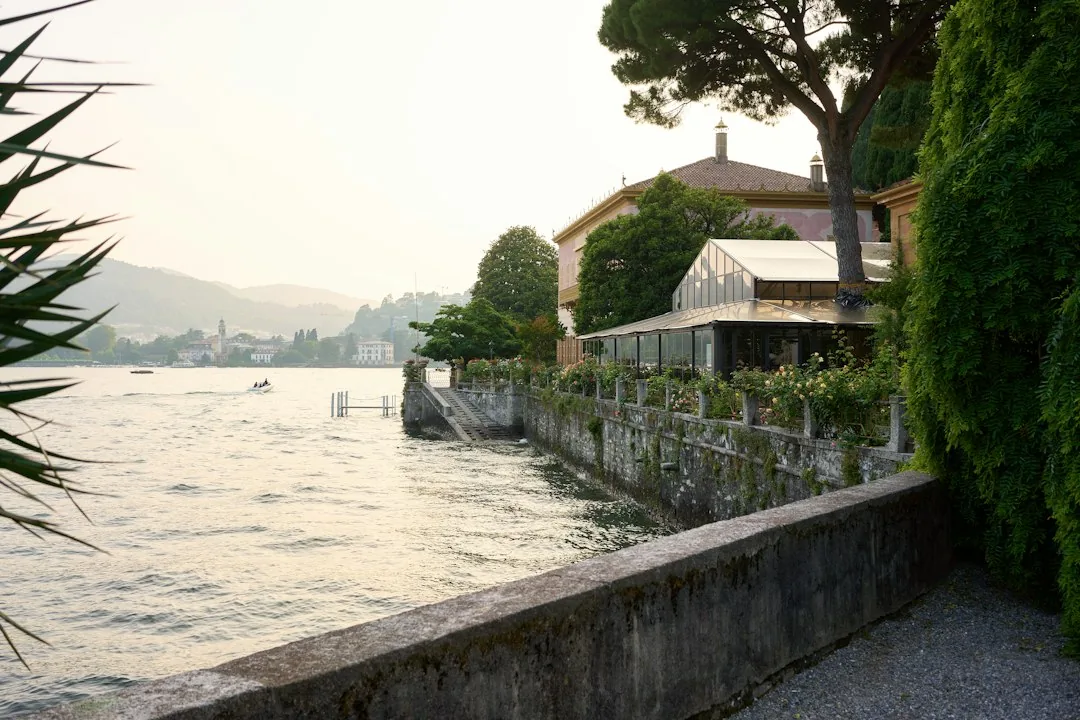
An Italian villa endures because durability is designed into its structure — proportion, orientation, thermal mass and masonry — not added as finish. The restored 1920s Lake Como villa featured by The New York Times proves the point: a house built in permanent material can be recovered a century later rather than replaced.
On October 16, 2026, The New York Times T Magazine published a feature on the restoration of a historic Italian villa on Lake Como — a project that returns the house, and a circa-1920s garden fountain designed by the architect Pietro Lingeri, to its original clarity. On its surface, it is a restoration story. Read closely, it is an argument about why certain houses are worth restoring at all.
Lingeri belonged to the generation of Italian Rationalists who worked around Como between the wars, pairing modern geometry with the lake's older villa tradition. What the Times documents is less a renovation than a recovery: proportion, stonework and water features brought back rather than replaced.
What makes an Italian villa endure for a century?
Durability is designed, not added. The Italian villa survives because its value lives in permanent elements — proportion, orientation, thermal mass and masonry — rather than in finishes that date. A house conceived this way can be restored a hundred years later; a house built around trends can only be replaced.
The typology has proven this repeatedly. Andrea Palladio's Villa La Rotonda near Vicenza, completed in 1566, still stands and still functions. Hadrian's Villa Adriana at Tivoli, built between 117 and 138 AD, remains legible nearly nineteen centuries later. The Lake Como villa in the Times feature joins a shorter but similar arc — built in the 1920s, intact enough to restore in 2026.
That is the quiet thesis of any serious restoration: you can only restore what was built to last. The fountain, the masonry, the load-bearing walls earn a second life because they were made of durable material, not because they were maintained perfectly. Lightweight or disposable construction does not get restored — it gets demolished and forgotten.
How does Lake Como's design logic translate to California?
Remarkably directly. The lakeside villa and the Southern California house face the same problem — how to live between indoors and landscape in a strong climate. The Italian answers are the same strategies that keep a Los Angeles house cool and grounded without leaning on mechanical systems.
- Thermal mass that moderates heat and holds the day's temperature in balance
- Courtyards and porticoes that frame light and channel air
- Orientation tuned to prevailing wind and sun
- Masonry and concrete that resist weather and time
These are not stylistic borrowings but environmental logic — which is why the typology keeps reappearing in California's canyons and along its coastline, from the Westside to Malibu. The lake and the Pacific demand the same discipline.
For the Los Angeles market, the lesson is timely. The city's luxury buyers increasingly want houses that read as permanent — assets that hold value and character across decades, not spec homes engineered for a five-year resale. A restored Lake Como villa is a vivid proof point: the decisions that matter most are made in structure and proportion, before a single finish is chosen.
It also reframes what "Italian villa" means in a California listing. The phrase is often reduced to a surface — terracotta, arches, a tile roof. The Lingeri project is a reminder that the real inheritance is structural intelligence: a building organized around light, mass and landscape. That is harder to fake and far more valuable, because it is the part that survives.
The villas that get restored a century from now are being built — or neglected — today. As California's most ambitious houses reach for permanence, the Lake Como model offers a clear brief: design for the century, build in material that can carry it, and let the finishes follow.