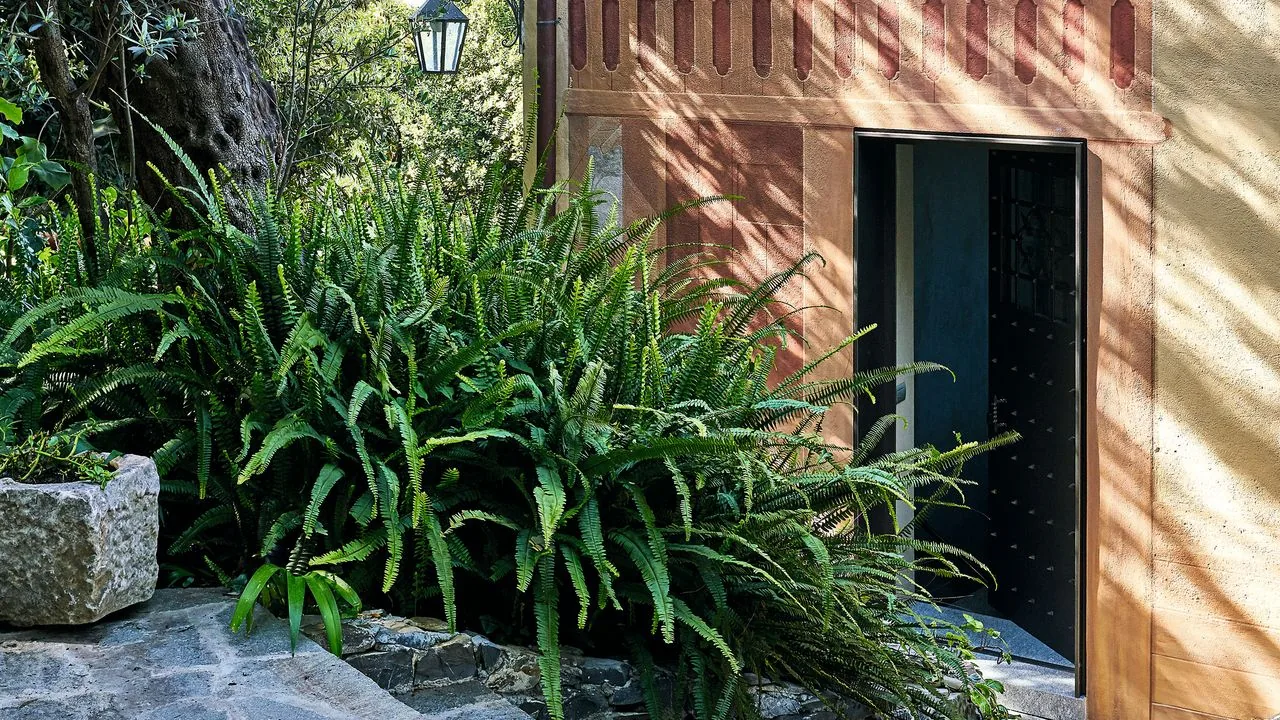
In a recent feature, Architectural Digest visits a historic villa in Genoa reworked by the studio M2Atelier. The magazine sums up the project in one line: "In this historic Italian villa there is nothing traditional, except for the location; nothing untouchable, except for an enchanted garden." The house keeps its original studded entrance door. Its painted facade decorations were restored by Decorarte. The garden is the protagonist, centered on a bougainvillea that, according to the piece, is 150 years old.
Source: Architectural Digest, photography by Lorenzo Pennati.
A Reversal of the Usual Hierarchy
Most renovations of historic houses treat the building as the protected object and the landscape as something that can change. As AD reports, this project does the reverse. The interior is open to reinvention: "nothing traditional." The one thing declared untouchable is the garden.
150 years — age of the bougainvillea at the heart of the garden, per Architectural Digest.
1 — element the designers treated as untouchable: the garden.
What was kept at the threshold is telling too. The studded door and the restored facade decoration are the parts of the house that face the street and the garden. They form the public face of the villa and its boundary with the landscape. The work inside can be fully contemporary because the edge between house and garden has been preserved.
A 150-year-old climber is a structural fact. A plant of that age has grown into its supports. Its weight, its reach and the shade it casts on the facade have been negotiated with the masonry over generations. Removing it, or rebuilding the wall it grows on, would erase a condition that cannot be bought back. The designers seem to have understood that the oldest living thing on the site sets the terms for everything else.
The oldest living thing on the site sets the terms for everything else.
What It Means for Los Angeles
Bougainvillea is native to South America, not Liguria. Southern California knows it as well as Genoa does: it spills over walls from Malibu to Beverly Hills. The two coasts share more than a climate. They share a planting vocabulary, and with it an opportunity that Los Angeles architecture rarely takes.
Too often, a new luxury house on the Westside is designed as an object, and the landscape is commissioned afterward to soften it. The Genoese villa suggests the opposite sequence. First decide what in the landscape must endure: a mature tree, a view corridor, a terrace that catches the late sun. Then design the house to frame it. In practice, that means planning the walls, pergolas and courtyards as supports for planting. It means asking which surfaces a climber will cover in thirty years, where shade will fall once it matures, and which edges of the house will be read through foliage rather than against sky.
This also changes the brief for materials. A garden designed to last a century needs garden architecture with a similar lifespan: walls that take a root system and constant irrigation without rot, and frames strong enough to carry a heavy, woody climber. In the Genoese case, the masonry has done that work for generations. A California villa intended to belong to its site should be specified with the same horizon in mind.
Typology, Not Pastiche
The lesson is not to import Ligurian ornament to Los Angeles. As AD's framing makes clear, almost nothing inside this villa is traditional. What carries over is a way of ordering priorities: a durable boundary, a free interior, and a landscape treated as the most valuable thing on the property. That combination is what makes a villa Italian, more than any decorative program.