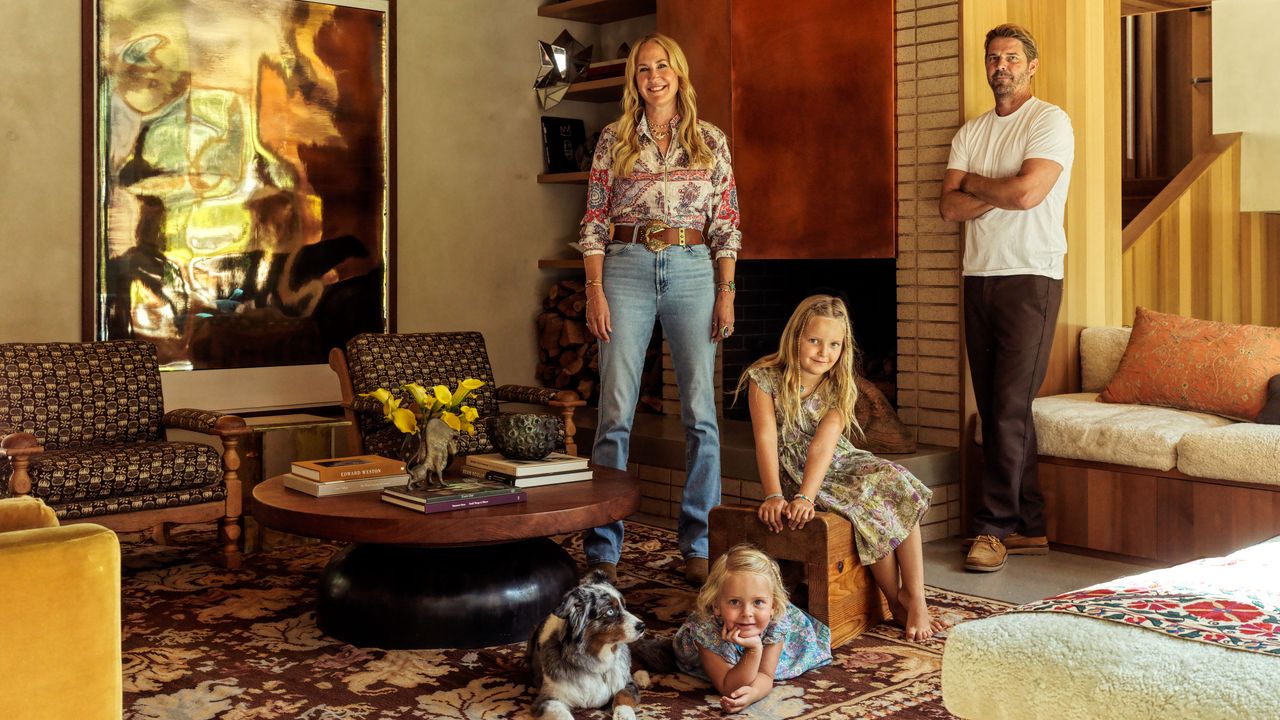
Architectural Digest has published a feature on Lela Becker's midcentury home in Pacific Palisades in which the defining amenity is not a view but a sound: frogs, parrots and a creek running through the property. The landscape work is described by the firm's project lead, Samuel Webb, as an effort to "amplify the qualities of this unique setting." Source: Architectural Digest
That verb — amplify — is worth pausing on. Most Los Angeles residential publishing measures a house by what it frames: ocean, canyon, city grid. Here the site is being read as an audible condition, and the architecture and planting are tuned to it. It is a quieter proposition than a view lot, and in permitting terms a considerably more complicated one.
A creek is a jurisdiction, not a feature
Any parcel in Southern California with running water attached to it carries a regulatory layer that hillside and flat lots do not. Under California Fish and Game Code section 1602, an owner must notify the Department of Fish and Wildlife before undertaking any activity that substantially diverts or obstructs the natural flow of, or substantially changes the bed, channel or bank of, a river, stream or lake — including work that deposits material where it could pass into those waters. Source: California Department of Fish and Wildlife, Lake and Streambed Alteration Program Grading, bank stabilisation, a bridge to a garage, even a drainage outfall can trigger it. On a riparian parcel the buildable envelope is defined less by the setback lines on the survey than by where the water and its banks say the house cannot go.
The acoustic side has its own literature. The World Health Organization's 2018 environmental noise guidelines recommend reducing residential road-traffic exposure below 53 dB Lden and 45 dB Lnight, on evidence linking sustained exposure above those levels to cardiovascular effects and sleep disturbance. Source: WHO Europe, Environmental Noise Guidelines Those numbers are written as public-health policy, but they describe a design variable most custom homes never quantify. A canyon parcel with moving water and a tree canopy is often already below them; a ridge lot above a boulevard frequently is not.
A site's soundtrack is a design brief. It tells you where the openings go, how thick the walls need to be, and whether the house can be cooled without a compressor running outside a bedroom window.
What this changes in the Los Angeles market
For two decades, price per square foot on the Westside has tracked sightlines. Sensory criteria — quiet, shade, air movement, the presence of water — have been treated as atmosphere rather than value. The Palisades house suggests the ordering is shifting, and the design consequences are concrete. A house built to be heard has to be openable, which means large operable glazing, deep shading, and a plan that cross-ventilates so mechanical cooling is the exception rather than the constant background. In a canyon setting it also means those openings need ember-resistant detailing and non-combustible surfaces at the perimeter — not as a compromise on openness, but as the engineering that permits it.
There is a materials consequence too. Landscape that carries a soundscape — a creek corridor, oak canopy, understorey planting — sits directly against the building at the exact zone where fire-smart practice asks for restraint in the first five feet. Reconciling the two is a drawing problem: gravel and stone thresholds, water held in engineered channels rather than loose banks, canopy kept high and clear of the roof plane. It is solvable, but only if landscape and building are designed in the same drawing set rather than sequentially.
The parcel as an instrument
The most interesting thing about the Palisades project is the discipline it implies. Amplifying a site means subordinating the building's own noise — mechanical, acoustic and visual — so the parcel can be heard. That is a harder brief than a spectacular elevation, and it produces houses that age differently, because the thing being preserved is not a look but a set of relationships between water, canopy, air and mass. Expect more Los Angeles clients to start asking what their land sounds like before they ask what it can be built up to.