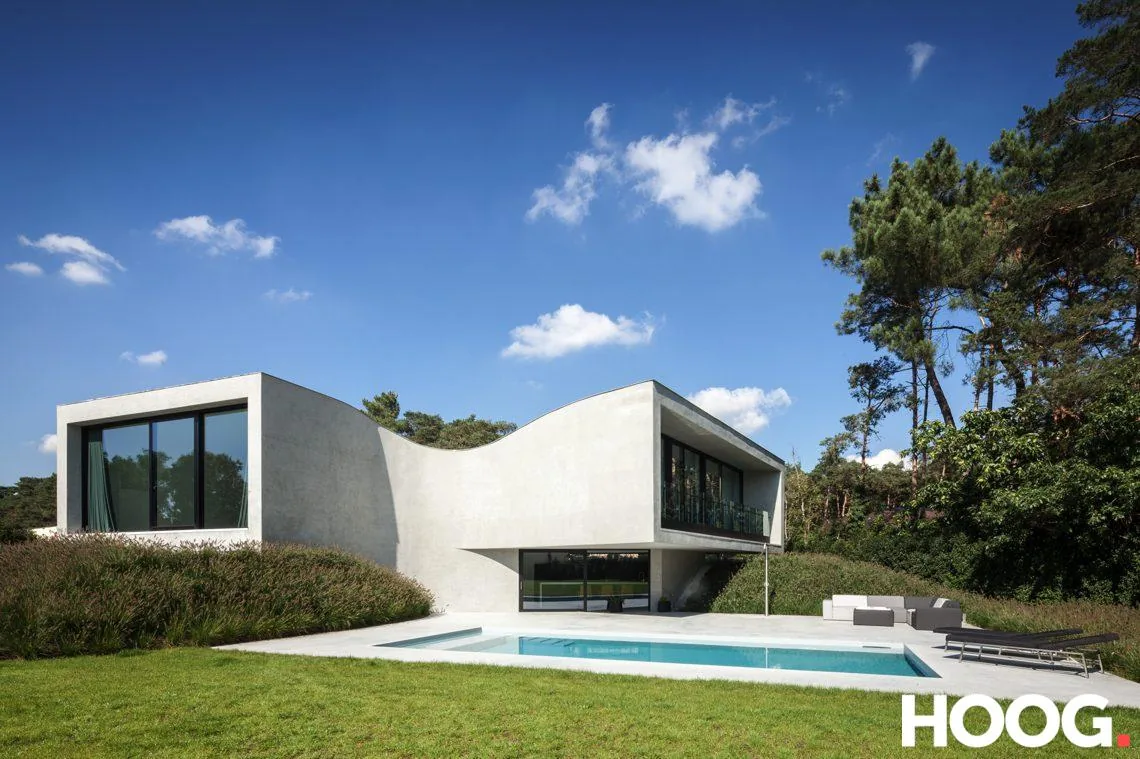
HOOG.design has published a look inside an organic villa by OOA | Office O architects, a house defined by curved facades and built in concrete. According to the HOOG.design feature, the concrete does two jobs. It is the structure, and it is also the finished architectural surface, so the sweeping volumes stay legible from the outside.
For an architect, the most interesting detail is the method. HOOG.design reports that the architects worked with concrete and conventional reinforcement rather than relying on special construction techniques (HOOG.design). Curved buildings are now often presented as products of parametric software and bespoke fabrication. This villa makes a quieter case: a curve can be a matter of craft that the builders execute, rather than a technology the client has to buy.
What the Project Demonstrates
Start with the first fact. When the structure is the finished surface, nothing sits between the geometry and the eye (HOOG.design). There is no skin smoothing a rough frame and no cladding approximating a radius. The curve you see is the curve that was cast. That is why HOOG.design describes the volumes as legible from the outside. The building's form and its construction are the same thing.
The second fact is just as important. Conventional reinforcement means ordinary bars, bent and placed by trades working to familiar standards (HOOG.design). In practice, this moves the difficulty of a curved concrete house somewhere else. The steel is not the hard part. The formwork is. Its radii, joints and tie patterns are what the finished facade records. On a fair-faced curve, every board line and pour joint stays visible, so the drawing of the formwork effectively becomes part of the design drawings.
This also explains the word "organic" in the project's framing. Here, organic does not mean free-form for its own sake. It means a continuous surface where structure and enclosure grow from one material. The villa treats curvature as something concrete does well when it is poured into a shape that has been carefully drawn and carefully built.
What It Means for Los Angeles
Los Angeles has a long appetite for curved residential form. Much of it, though, has been achieved by building a framed shape and then plastering it into a curve. In that approach the curve belongs to the finish, not the structure. It looks right on completion. Its edges, soffits and transitions, however, depend on the skin holding its line year after year. A project like OOA's resets the comparison: the radius is built into the wall itself.
For clients commissioning custom homes in Malibu, Beverly Hills or the canyons, this matters for three reasons. First, hillside lots seldom offer orthogonal sites. A curved concrete wall can follow a contour while also retaining earth, so one element resolves both the terrain and the architecture. Second, design teams no longer need to assume that a curve calls for a specialist fabrication chain. The HOOG.design feature shows a curved house delivered with conventional reinforcement (HOOG.design). That should make the curve a reasonable conversation with experienced concrete trades rather than a premium experiment. Third, it changes where the design effort goes. If the structure is the facade, the decisions about joints, tie holes, pour sequence and surface tone are architectural decisions, and they have to be made early.
The risk is the reverse of the opportunity. A cast surface does not forgive. A badly set out form or a poorly placed joint stays visible for the life of the building. Getting a curve in raw concrete right is therefore a test of the whole team's discipline, from the first sketch to the last pour.
Looking Ahead
The most useful lesson from OOA's villa is not stylistic. It is the confidence that sculptural residential form can rest on ordinary construction intelligence. As more Californian clients look for homes that are both expressive and enduring, we expect the conversation to shift away from what software can generate and toward what a skilled team can cast. The curve that lasts will be the one the structure itself carries.