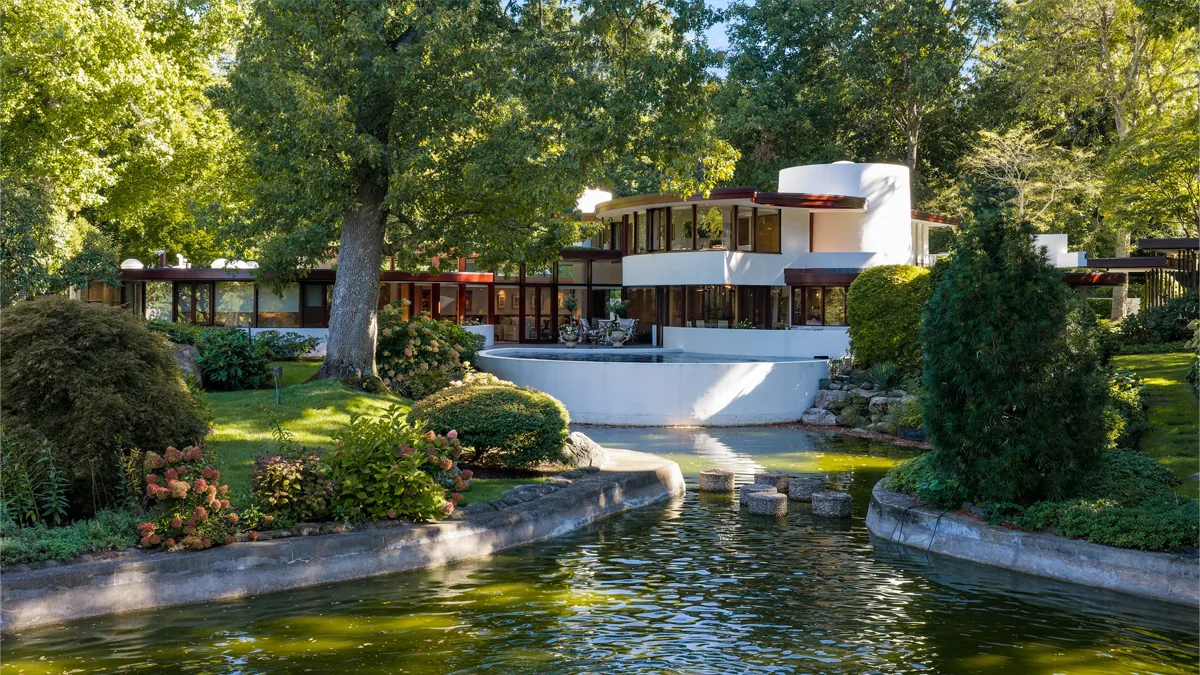
Robb Report has listed a Fairfield County estate in New Canaan, Connecticut, for $6.2 million — the first time the house has changed hands in three decades. The feature carrying the headline is not the acreage, the interiors, or the provenance, but an Olympic-size pond cast in concrete: a water element scaled like civic infrastructure and set quietly into a private landscape. Source: Robb Report, “This $6.2 Million Connecticut Home Comes With an Olympic-Size Concrete Pond.”
Concrete moves from the foundation to the foreground
New Canaan is modernist territory — the town the Harvard Five chose at mid-century, a short drive from Philip Johnson's Glass House. That lineage treated raw material as finish rather than as something to be clad over, and a pond cast in concrete sits comfortably within it. What is notable is the role the material plays in the sale. Concrete here is not the hidden substrate beneath a lawn or a pool liner; it is the most memorable gesture on the property, the thing the listing leads with.
That inversion matters. For most of the last century, concrete in a luxury residence was infrastructure — foundations, retaining walls, the shell of a pool — and the design budget went to covering it. The New Canaan listing treats the cast surface itself as the amenity, priced into a $6.2 million ask and preserved, unchanged in character, across thirty years of ownership.
Part of the appeal in a house of this kind is that concrete ages without apology. A fair-faced wall records the grain of its formwork and the light that crosses it; a cast pond holds its edge while the planting around it matures. Buyers who pay for this are buying a surface meant to be seen, touched, and kept — not refreshed every renovation cycle.
$6.2M — Asking price for the New Canaan estate.
30 years — Time since the house last traded.
Olympic-size — The scale of the concrete pond leading the listing.
What it signals for the Los Angeles market
Los Angeles has its own concrete modernist pedigree, from the cast houses of the postwar hills to the museum-grade work that still defines the city's cultural architecture. A listing like this confirms that the appetite for concrete as a visible, tactile luxury finish is not a regional quirk; it is a broad shift in what serious buyers read as permanent and considered.
The difference is what the material is asked to do once it crosses into California. In Fairfield County, a concrete pond is an aesthetic decision with little consequence beyond maintenance. In Malibu, Beverly Hills, or the canyons, the same cast material is also the most non-combustible, lowest-maintenance envelope a site can carry — a design choice and a resilience choice at once.
The beauty argument and the resilience argument for concrete are, in California, finally the same argument.
That is the quiet lesson in a Connecticut listing for a Los Angeles buyer. The material was always capable of carrying both the look and the longevity; California simply raises the stakes of choosing it, and rewards the buyer who treats it as architecture rather than as a cost to be hidden.
Where this is heading
As concrete migrates from the foundation to the foreground of luxury design, the question for California buyers shifts. It is no longer whether the material belongs in a beautiful house — a $6.2 million listing settles that. It is how early in the drawing the material gets to speak, and how much of the house it is allowed to become.