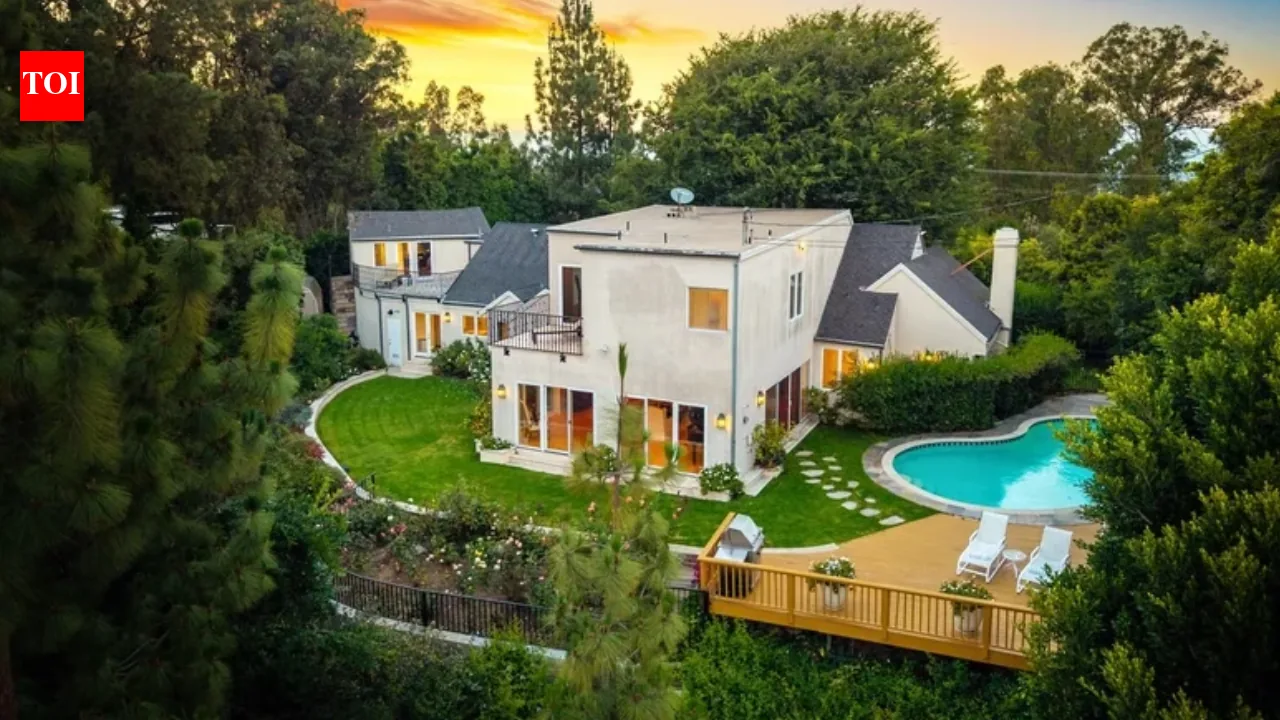
A Beverly Hills house built in 1941 for horror-film icon Boris Karloff, and later owned by Academy Award-winning actor Gregory Peck, is back on the market at $6.5 million, according to The Times of India. The seller is Robert Guza Jr., the former head writer of General Hospital. His household bought the property for about $2.8 million in 2003. The Times of India calls the estate preserved, and that one word carries the story. In a city where pre-war houses are often valued as land, this one returns to market as a house.
Source: The Times of India
Eighty-Five Years in Three Chapters
The report lays out the timeline. The house was commissioned for Karloff in 1941, passed later to Gregory Peck, and was acquired in 2003 for roughly $2.8 million by the writers now selling it (Times of India). Twenty-three years later, the asking price is $6.5 million.
Two cautions belong next to those figures. First, $6.5 million is an asking price, not a closed sale. Second, the gap between the two numbers does not separate land from structure, and it does not account for what the owners spent to keep the house in its current state. Taken at face value, our own arithmetic puts the move from about $2.8 million to $6.5 million at roughly 132% over 23 years, or about 3.7% a year compounded. That is a respectable line for a residence. It is not a spectacular one, and it has not yet been tested by a buyer.
The more telling figure is the third one. Eighty-five years is long enough for a house to outlive its original owner, its most famous owner, and most of the houses built around it in the same decade.
Why Some Houses Get Kept
Beverly Hills rarely rewards sentiment for its own sake. A famous name can draw a showing, but it does not explain why a succession of owners chose stewardship over replacement. That choice is usually architectural. In our experience, the houses that reach their ninth decade intact tend to share a few qualities. Their plans are legible. Their rooms are proportioned for daylight rather than for furniture. Their relationship to the garden was resolved at the start, not added later. A house with that kind of order gives each new owner a reason to adapt it at the edges and leave its core alone.
A house that reaches its ninth decade intact has passed the only test that matters: each owner chose to keep it.
The opposite case is just as familiar on the Westside. A house without a strong spatial idea becomes a sequence of renovations, each erasing the last, until the lot is worth more empty. The difference rarely comes down to style. It is whether the original design left anything worth inheriting.
For anyone commissioning a custom home in Beverly Hills today, the Karloff listing is a useful benchmark. Provenance can be bought only once. Permanence has to be designed in.
Looking Ahead
The houses being drawn in Beverly Hills now will meet their own version of this test. It probably will not come at the first resale, but at the third or fourth, when an owner who never met the architect decides whether the house is worth keeping. If one of them comes to market in 2111 described as preserved, it will have earned that word for the same reasons the Karloff house has.