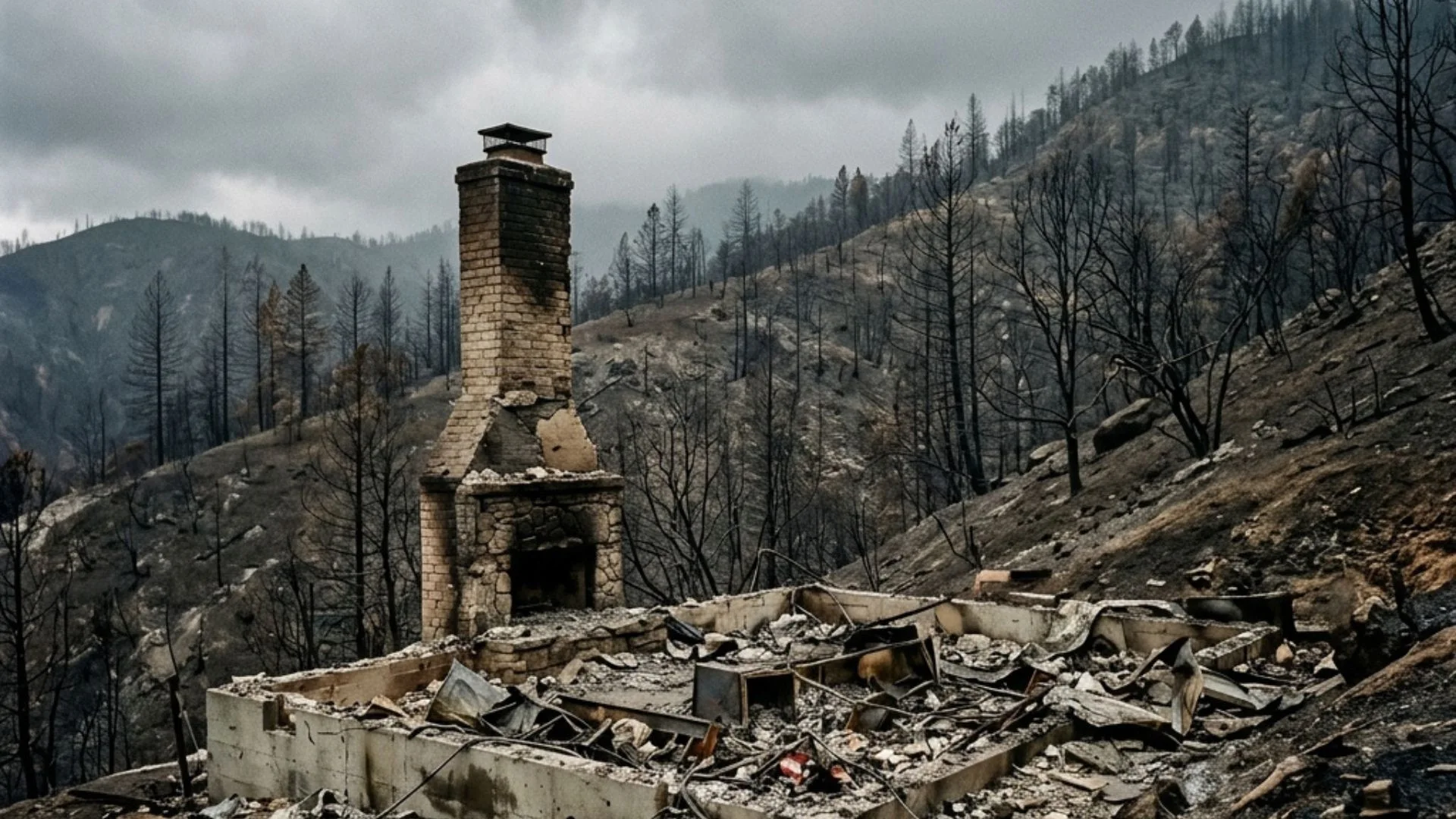
A Los Angeles attorney reviewing a client's homeowners policy found a deductible of $621,000 that applies only to wildfire losses, according to Live Insurance News. The figure was not a typo and not an error. It was a percentage deductible — a clause that scales with the insured value of the home rather than sitting at a flat dollar amount — and it was buried in replacement coverage the homeowner accepted after their original insurer declined to renew.
The sequence matters. It begins, as Live Insurance News describes, with a non-renewal: a major insurer stops writing policies in a fire-risk area. The homeowner finds replacement coverage, signs, and assumes the gap is closed. The deductible language, expressed as a share of dwelling value, only becomes a six-figure reality at the moment of a claim.
How a percentage deductible becomes a six-figure number
Flat deductibles are the form most homeowners recognize — a fixed amount subtracted from any covered loss. A percentage deductible behaves differently. It is calculated as a portion of the insured value of the structure, which means the more a home is worth, the larger the out-of-pocket exposure before coverage begins. On a high-value Los Angeles property, a single-digit percentage applied only to wildfire claims can resolve into hundreds of thousands of dollars, as the $621,000 figure reported by Live Insurance News demonstrates.
$621,000 — wildfire-only deductible discovered in a single Los Angeles homeowners policy (Live Insurance News).
12 — Safer from Wildfires mitigation measures California insurers must recognize with premium credits, per the California Department of Insurance.
What gives the clause its force is that it is structured to be invisible until tested. It is not a coverage exclusion, so it does not announce itself as a gap. It is a deductible — technically still insurance — that simply shifts an enormous share of wildfire risk back onto the homeowner. The California Department of Insurance's Safer from Wildfires framework requires insurers to credit mitigation across structure, parcel, and community layers — but credits operate on premium, not on the deductible terms a non-renewed homeowner may be forced to accept from a replacement carrier.
What this signals for the LA market
For Los Angeles, this is a story about where risk hides after a non-renewal. The market has spent two years focused on whether coverage exists at all. This case sharpens the question: coverage can exist and still leave a homeowner functionally exposed, because the burden migrates from the premium line to the deductible line, where fewer buyers think to look.
A wildfire-specific percentage deductible is, at root, the underwriter's verdict on the structure. It says: we will write this, but we will not absorb the first large slice of fire loss, because we cannot price down what this building will do when an ember front arrives. The variable the homeowner can actually move is not the clause — it is the structure the clause is reacting to. A non-combustible envelope, ember-resistant openings, and a cleared perimeter are the inputs that let an underwriter offer terms that do not quietly transfer six figures of risk back to the owner.
The lesson for buyers commissioning new construction is procedural as much as architectural: read the deductible page as carefully as the coverage page, and understand that both are downstream of how the home is built.
The fine print is a structural verdict
As replacement-of-last-resort policies proliferate across fire-exposed Los Angeles, the most consequential numbers will increasingly live in the deductible language rather than the headline premium. The homes that earn cleaner terms will be the ones that give an underwriter the least to doubt — and that case is made in concrete, not in the contract.