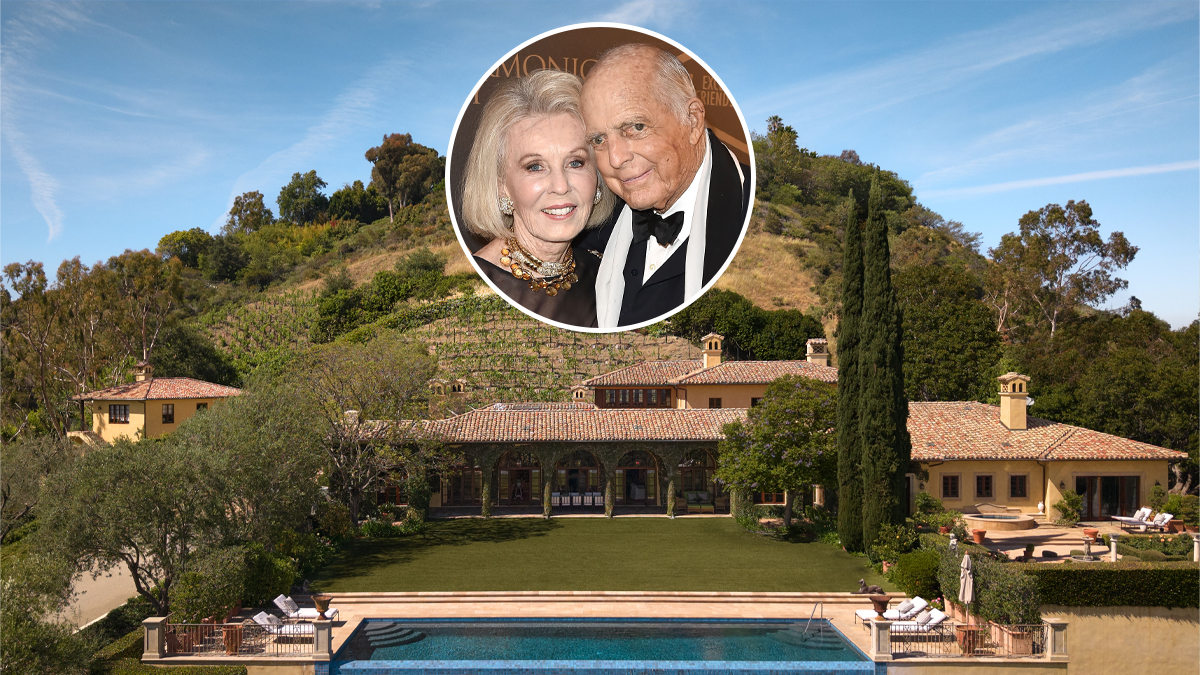
A Tuscan-style estate in Bel Air has entered the market at $65 million, according to Robb Report. The property — known as Villa Cresta and long held by the family of late financier John Hotchkis and Kennedy Center trustee Joan Hotchkis — spans four acres and includes a private vineyard, a rarity even among the Westside's largest holdings.
The listing is notable less for any single feature than for what it represents: a fully realized Italian-country villa typology, on substantial acreage, asking a price at the upper band of the Bel Air market. It is a clean data point on how the Mediterranean form is valued when it is executed at scale.
The Numbers Behind the Listing
The estate's defining attributes — the four-acre footprint and the working vineyard — are the kind of land assets that rarely change hands in the Westside's hillside enclaves, where parcels of this size are increasingly scarce. Robb Report frames the home as a Tuscan country estate, a deliberate stylistic lineage that anchors the property's identity and, by extension, its pricing logic.
$65M — list price for the 4-acre Bel Air Tuscan estate (Robb Report)
4 acres — land area, including a private vineyard (Robb Report)
Bel Air sits within the Westside's most insurance-pressured corridor, where fire-hazard zoning increasingly shapes underwriting decisions and where land of this scale carries both prestige and exposure. The combination of acreage, a recognizable European typology, and a top-of-market price makes the listing a useful benchmark for how buyers weigh form, land, and permanence in 2026.
It also reinforces a pattern visible across Bel Air, Beverly Hills, and Malibu: the Mediterranean and Italian-villa vocabulary continues to command a premium precisely because it signals durability and timelessness rather than a passing architectural moment.
What It Means for the LA Market
A $65 million ask for a Tuscan estate tells you the villa form is not a niche taste in Los Angeles — it is a value anchor at the very top of the market. Buyers in this bracket are not chasing novelty; they are paying for spatial language that has proven itself over centuries.
The Mediterranean villa holds value in Los Angeles because it reads as permanent — and permanence is increasingly an underwriting question, not only an aesthetic one.
But there is a quieter variable beneath the style. In fire-exposed Westside geographies, the long-term value of any luxury home is increasingly tied to its construction system — whether it can be insured affordably, and whether it will endure without continual reinvestment. A villa's silhouette can be replicated. Its resilience cannot be faked. As insurability becomes a structural input into resale value across California, the question for buyers shifts from how a home looks to what it is built from.
For the LA luxury market, listings like Villa Cresta are a reminder that the most enduring asset is the one whose form and substance are aligned.