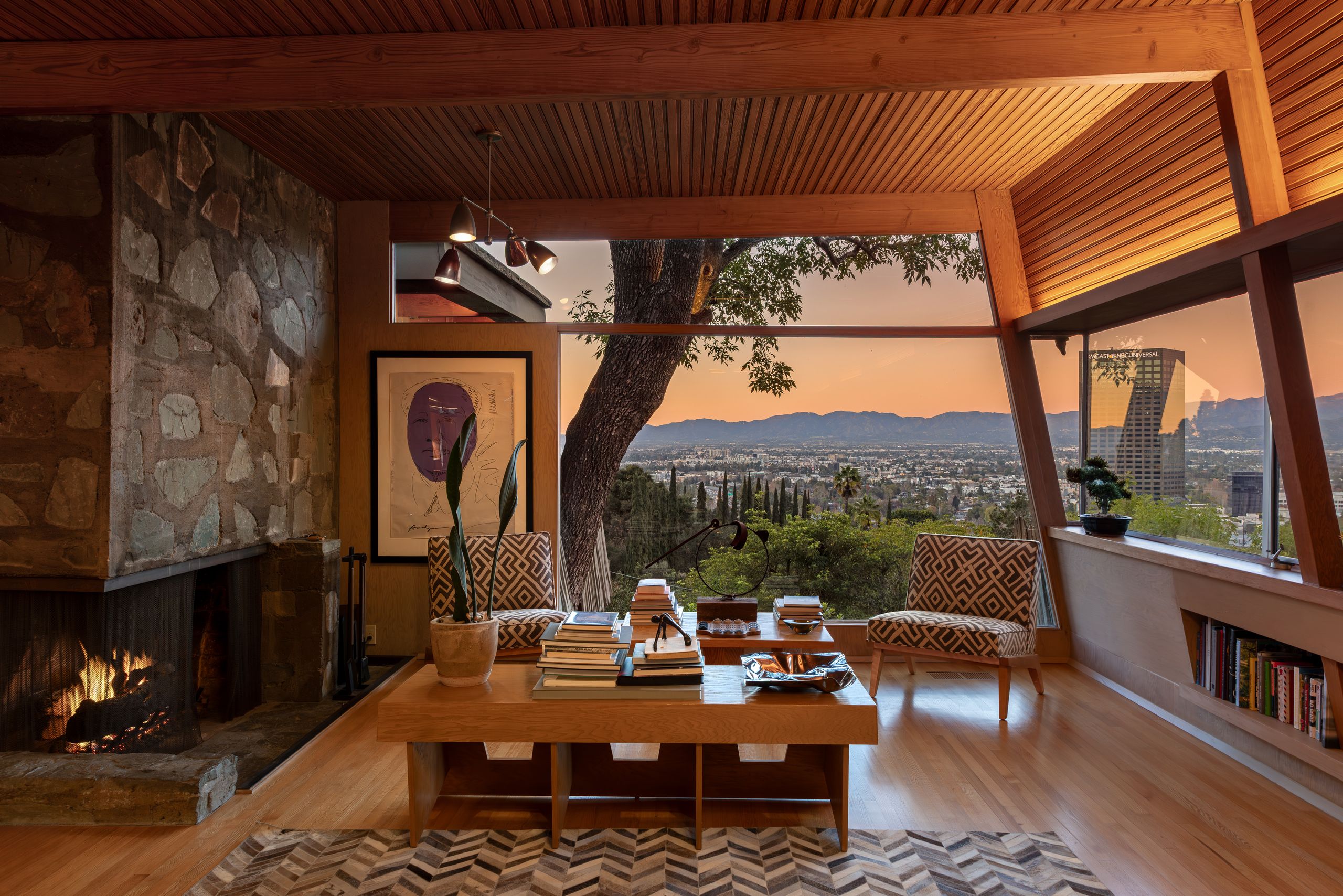
Wallpaper* this week published a survey of sixteen Rudolph Schindler houses still standing in Los Angeles, from the 1922 Kings Road House in West Hollywood to lesser-known hillside commissions in Silver Lake, Studio City and the Hollywood foothills. The piece reads as a tour, but it is also, quietly, a data set: a century of residential architecture in a fire-exposed city, much of it built in concrete, almost all of it still inhabited.
For a Los Angeles luxury market re-debating what a new home should be made of, the timing is useful. Schindler is not a footnote — he is the longest residential experiment in concrete the city has ever run.
A century of concrete houses, still standing
The Wallpaper* catalogue covers Schindler's full Los Angeles arc: the Kings Road House (1922), the Lovell Beach House lineage, the How House in Silver Lake, the Buck, Oliver and Tischler residences, and a series of canyon and hillside projects from the 1930s and 1940s. The unifying thread is not style — Schindler's vocabulary shifted significantly across four decades — but construction system. Many of these houses are built around concrete: tilt-slab walls, exposed structural piers, integral floors.
The Kings Road House, completed in 1922, is the clearest case. As documented by the MAK Center, which now stewards the property, Schindler designed the residence using tilt-slab concrete walls cast on the ground and raised into position — a technique borrowed from industrial construction and applied, unusually for its moment, to a single-family home. The house has now stood on Kings Road for more than a century, through earthquakes, urban densification, and multiple Los Angeles fire cycles.
Sixteen surviving Schindler residences is not a trivial number. It is, in effect, a longitudinal study of how concrete-framed houses behave in the Los Angeles basin over decades — a data set the wood-framed mid-century inventory cannot match at the same scale.
What the survey reveals about LA's residential canon
Los Angeles tells two stories about itself architecturally. One is the wood-framed Case Study idiom — light, demountable, photographed by Julius Shulman, mythologised globally. The other, less photogenic, is the European-inflected concrete tradition that Schindler, Richard Neutra and their successors quietly embedded in the hillsides. The Wallpaper* feature is essentially an argument that the second story deserves equal billing in the city's residential canon.
That argument lands differently in 2026 than it would have a decade ago. The 2026 California WUI Code (Title 24, Part 7) is now in its first full operating year. Insurance underwriting has shifted decisively toward non-combustible envelopes. The Westside ultra-prime market has begun listing monolithic concrete houses as headline features rather than back-of-spec disclosures. In this context, a survey of houses that have been standing in concrete since the Coolidge administration is less a heritage essay and more a market signal.
Why this matters for new construction in LA
The practical takeaway is not nostalgia. Schindler's tilt-slab is not the construction system anyone would specify today — modern reinforced concrete, ICF assemblies, and engineered precast offer better seismic performance, thermal mass control, and fire ratings than 1920s techniques. The takeaway is about the underlying bet: that in a city defined by fire cycles, seismic risk and a hundred-year cycle of architectural fashion, concrete houses tend to outlast their owners.
The luxury market is beginning to price this asymmetry. A reinforced concrete home in a Fire Hazard Severity Zone is no longer an aesthetic choice — it is an insurability choice, a maintenance choice, and increasingly a resale choice. Schindler did not build for that argument. But the houses he left behind happen to make it for him.
Looking forward
A century from now, the residential survey of 2126 Los Angeles will likely include very few of the wood-framed houses being built today. It will include some of the concrete ones. Which side of that ledger a new commission lands on is, fundamentally, a decision made in the first ten months of design — before finishes, before furniture, before insurance is bound.