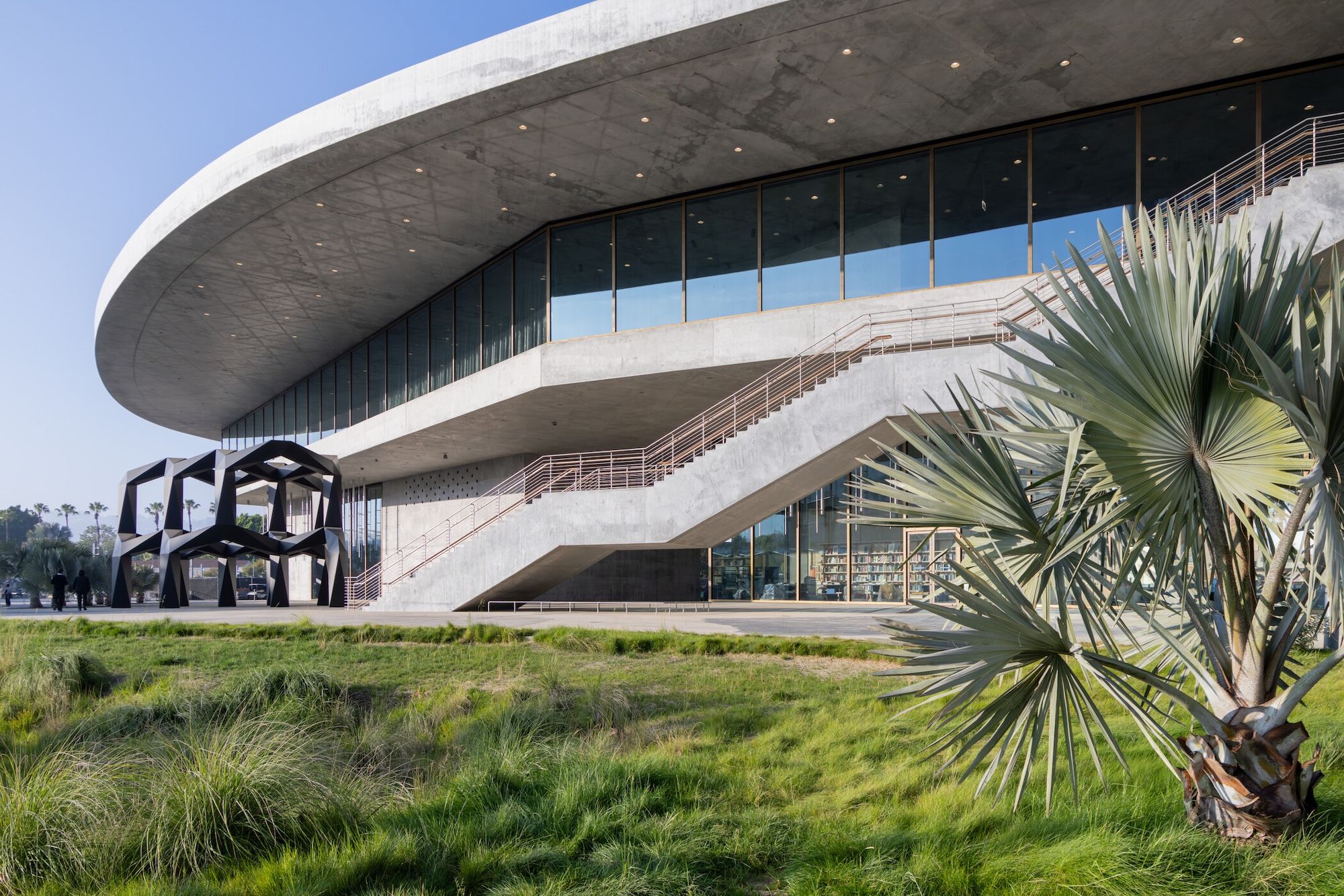
Wallpaper* has published a striking reassessment of LACMA's David Geffen Galleries — the long-debated Peter Zumthor building that finally opened to the Los Angeles public this year. The piece, titled I wanted to hate the new LACMA. Then I went back, is unusual in the architectural press: a critic walking back early skepticism after spending time inside the finished concrete volume that now spans Wilshire Boulevard. Source: Wallpaper*, April 2026.
The reassessment matters because the Geffen Galleries is, materially, the most ambitious civic concrete project Los Angeles has commissioned in a generation. And it has arrived at a moment when the city is rethinking what to build with — and how long it should last.
A concrete civic object on Wilshire
The David Geffen Galleries replace four of LACMA's older pavilions with a single horizontal volume: 347,500 square feet of curatorial and public space, lifted on piers and bridging Wilshire Boulevard, with cast-in-place concrete as the dominant structural and finished surface (LACMA). Zumthor's building is, in essence, one continuous concrete plate carrying the museum's permanent collection above the street.
Wallpaper*'s critic notes that the early renderings drew almost universal hostility — the form was read as monolithic, the program criticized for shrinking gallery walls. Inside the finished building, the reading shifts. The concrete reads as warm rather than oppressive; the daylighting strategy and the slow procession through the galleries change how visitors experience permanence at scale (Wallpaper*).
347,500 sq ft — total area of the David Geffen Galleries.
One continuous concrete plate — the structural gesture that carries the entire collection.
2026 — the year the building entered public life on Wilshire Boulevard.
Why this matters for the LA conversation about material
Los Angeles is not a city that historically reads itself in concrete. The dominant residential lineage — the Case Study houses, the post-and-beam tradition, the wood-framed hillside vernacular — is light, modular, and impermanent by design. The Geffen Galleries inserts a different material logic into that lineage: a building intended to age slowly, in a single material, on a civic boulevard.
That logic has practical resonance for a city now writing the 2026 California WUI Code into every new permit in a Fire Hazard Severity Zone, and for clients commissioning luxury homes at a moment when underwriters are pricing materials, not square footage. When a building's structure and its finished surface are the same non-combustible material, the conversation about envelope, insurability, and lifecycle compresses into a single decision made at the drawing-board stage.
A civic precedent for residential ambition
The Wallpaper* reassessment is also a useful corrective to the assumption that concrete is cold or alien in Southern California. Inside the Geffen, the material is calibrated for light, proportion, and tactility — the qualities Mediterranean and Italian villa traditions have used for centuries to make heavy buildings feel domestic. The civic version of that argument is now standing on Wilshire. The residential version is what serious LA clients are beginning to commission on hillside lots in Malibu, Beverly Hills, and the Westside.
If a museum can rehabilitate concrete in the public imagination, the residential market follows. The Geffen Galleries gives Angelenos a built reference — a place to walk through and decide, in person, whether material permanence belongs in their next house.
The next test will be whether the residential pipeline answers in kind: not with one-off concrete trophy houses, but with a steady production of homes engineered, like the Geffen, around the assumption that the material itself is the architecture.