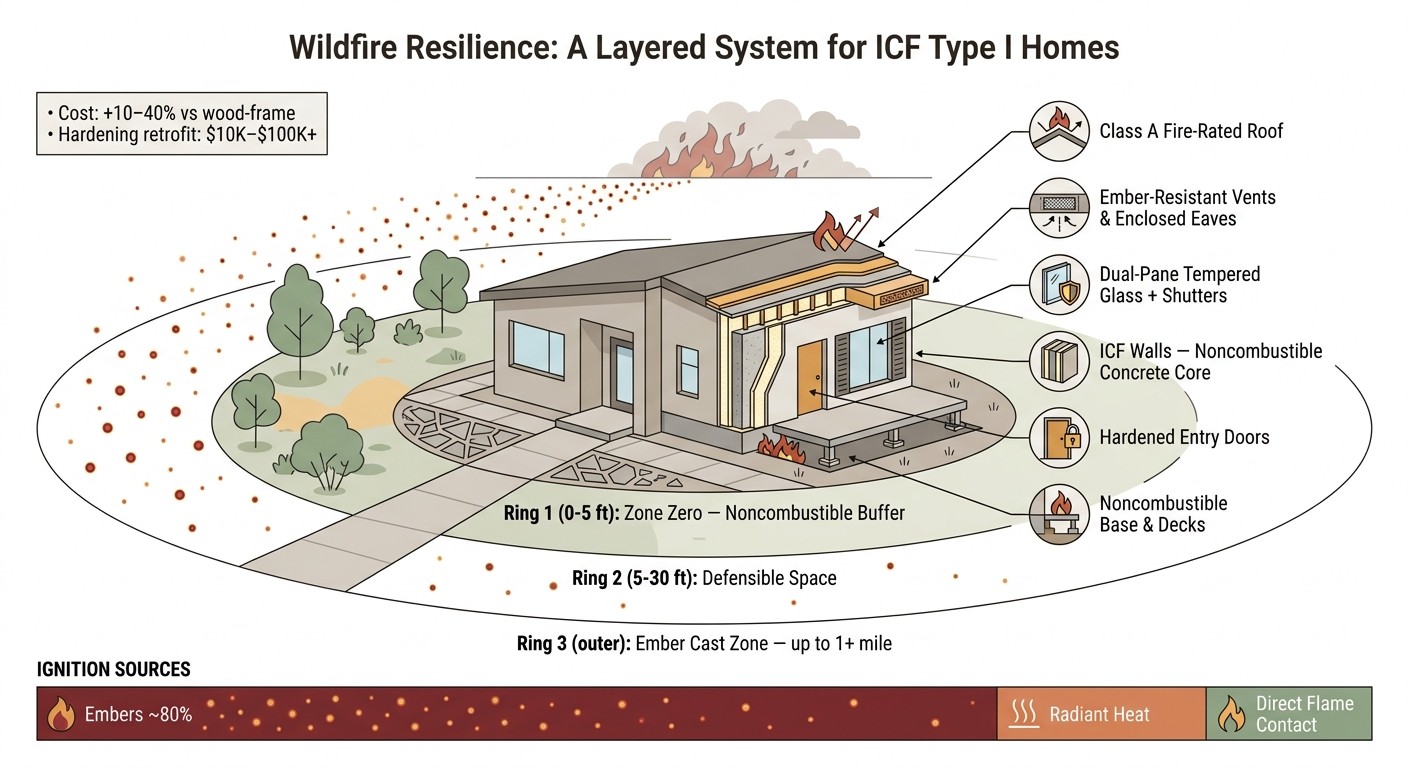
Builtech Construction Group has published a profile of what it describes as California's first known ICF residence built to Type I construction classification, the highest tier in the International Building Code. The article frames the project as a new wildfire standard for the state, applying a construction grade typically reserved for hospitals, high-rises and civic infrastructure to a single-family home. For California's luxury residential market — where insurability and structural performance are now underwriting variables, not aesthetic ones — the precedent is significant.
What Type I Actually Means
Construction types in the International Building Code are not marketing categories. Per the 2021 IBC Chapter 6, Type I construction requires noncombustible structural elements and the longest fire-resistance ratings of any classification — typically three hours for primary structural frame, two hours for floors, and one to two hours for interior bearing walls. Type II is also noncombustible but with reduced ratings. Types III through V allow varying degrees of combustible material; Type V — wood-frame — is the dominant classification for California single-family homes, including most homes in Wildland-Urban Interface zones.
Insulated Concrete Forms — stay-in-place foam molds filled with steel-reinforced concrete — produce a monolithic, noncombustible structural envelope. The Builtech profile positions ICF as the assembly that makes residential Type I economically viable, because the same wall delivers structure, insulation, and fire-resistance rating in a single pour rather than as layered subsystems.
The classification gap is the story. A Type V luxury home and a Type I luxury home can look identical from the street and price within ten percent of each other — but the IBC treats them as different categories of building. Underwriters are beginning to do the same.
Why This Lands in California Right Now
The timing is not coincidental. California's wildfire insurance environment has pushed structural classification from a code-compliance footnote to a commercial variable. The Safer from Wildfires regulation, administered by the California Department of Insurance, requires admitted carriers to recognize a 12-measure mitigation framework spanning structure, parcel, and community. Type I construction satisfies the structural layer by definition rather than by accumulation of upgrades.
For a luxury client, the practical question is whether a residential project earning a commercial-grade classification produces a different conversation with the carrier, the lender, and the appraiser. Builtech's profile suggests it does — particularly in the high-severity Fire Hazard Severity Zones where conventional construction is increasingly difficult to insure on the admitted market.
Implications for the LA Market
Los Angeles has been moving toward this benchmark indirectly. The 2026 California WUI Code raises baseline requirements for new construction in fire-exposed zones, and IBHS Wildfire Prepared Home certification is now referenced by multiple admitted carriers. But these are mitigation overlays on existing construction types, not a reclassification of the building itself.
A residential Type I project sets a different reference point. It tells the architect, the builder, and the underwriter that the structural shell is rated to commercial standards before any of the wildfire-specific details — vents, eaves, glazing, defensible space — are layered on. The premium is real, but the variable being priced is no longer 'a luxury home with fire upgrades.' It is a different category of asset. Whether the rest of the LA luxury market follows depends less on aspiration than on whether carriers and appraisers begin treating Type I residential as a separate underwriting class.
What Comes Next
First-of-kind projects rarely stay singular for long once they clear permitting and insurance. The signal worth watching is whether the second, third and tenth Type I residences appear in Malibu, Calabasas and the Palisades — and whether the appraisal and underwriting infrastructure around them begins to recognize the classification as a distinct tier rather than an unusual choice.