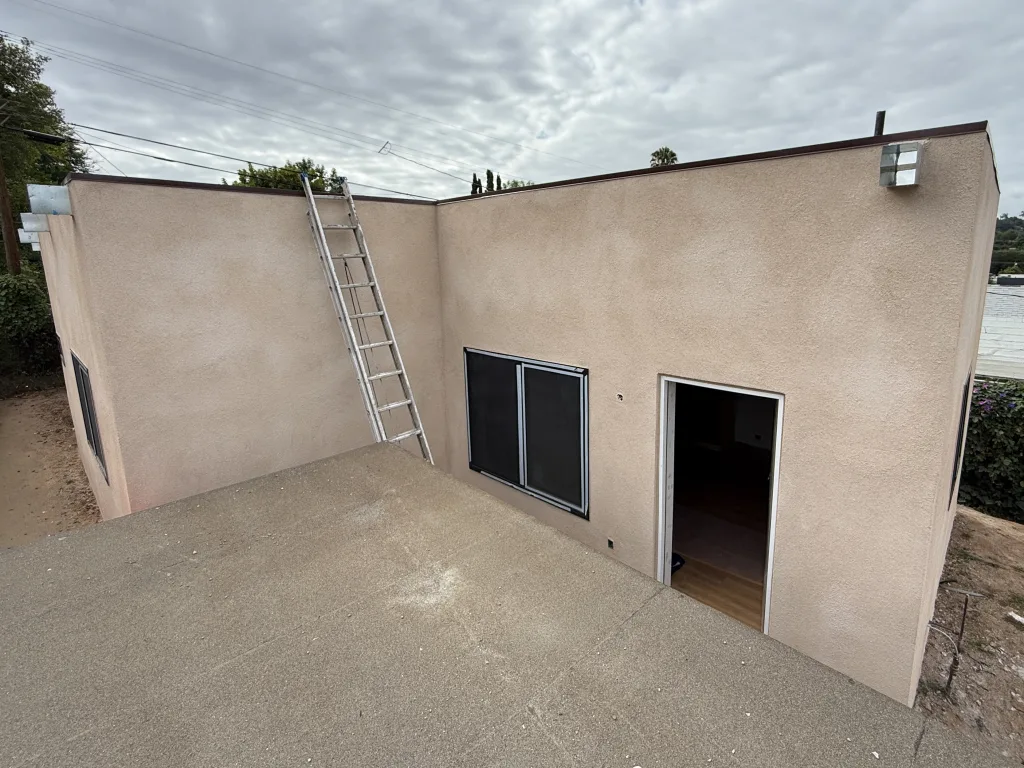
A single small building in Los Angeles is being read as a model for something much larger. According to Davis Vanguard, Builtech Construction has completed what may be the city's first accessory dwelling unit built with insulated concrete forms to Type I fire-resistance standards. The publication frames the project not as a one-off curiosity but as a "blueprint for resilient housing" in a region where wildfire exposure now shapes both code and coverage.
The significance is less about the unit's size than about its classification. Type I is a designation usually reserved for institutional and high-rise construction — buildings whose structural materials, not just their cladding, are non-combustible. Applying that standard to a backyard dwelling reverses the usual hierarchy, where the smallest structures are built to the lightest spec.
Why a small build carries outsized weight
In California, fire-resistant construction has largely meant treating the exterior of an otherwise combustible building — Class A roofing, ignition-resistant cladding, ember-resistant vents. That work satisfies Chapter 7A of the California Building Code, which governs exterior wildfire exposure in Fire Hazard Severity Zones. Type I construction is a different proposition: it concerns the structural materials themselves. Insulated concrete forms — a continuous reinforced-concrete core poured between rigid insulation — deliver a non-combustible structure rather than a protected one.
That distinction matters to the people who decide whether a home is insurable. California's Safer from Wildfires framework, administered by the California Department of Insurance, requires insurers to recognize mitigation across three layers — structure, parcel, and community — and to offer discounts for measures adopted. A building whose envelope is inherently non-combustible meets the structure layer at its source rather than through add-ons that age, weather, or get removed in a future renovation.
Type I — fire-resistance class achieved by LA's first known ICF-based ADU (Davis Vanguard, 2026)
3 layers — structure, parcel, and community mitigation recognized under California's Safer from Wildfires framework (CDI)
What it signals for the LA market
An ADU is an unusually honest test case. There is no luxury square footage to dilute the question, no sweeping facade to distract from the assembly. The structure either is non-combustible or it is not, and at this scale the answer is visible. That clarity is precisely why the project reads as a blueprint: it demonstrates that Type I construction is buildable at residential scale and residential budgets, not only in towers.
When the smallest building on a lot is built to the strictest fire-resistance class, it quietly resets expectations for everything around it.
For owners weighing a rebuild or a new build in fire-exposed parts of Los Angeles, the implication is straightforward. The market is beginning to distinguish between a home that has been made fire-resistant and a home that was built non-combustible. As insurers narrow their appetite and price increasingly on the structure layer, that distinction moves from architectural preference to underwriting input — and a backyard unit has just shown it can be done.
The road ahead
If a single ADU can reach Type I, the question facing larger projects is no longer whether non-combustible structure is achievable, but why the primary residence would settle for less. Expect the conversation in LA's fire zones to keep migrating from treatments applied to a frame toward the material of the frame itself — and for the smallest buildings, paradoxically, to keep setting the pace.