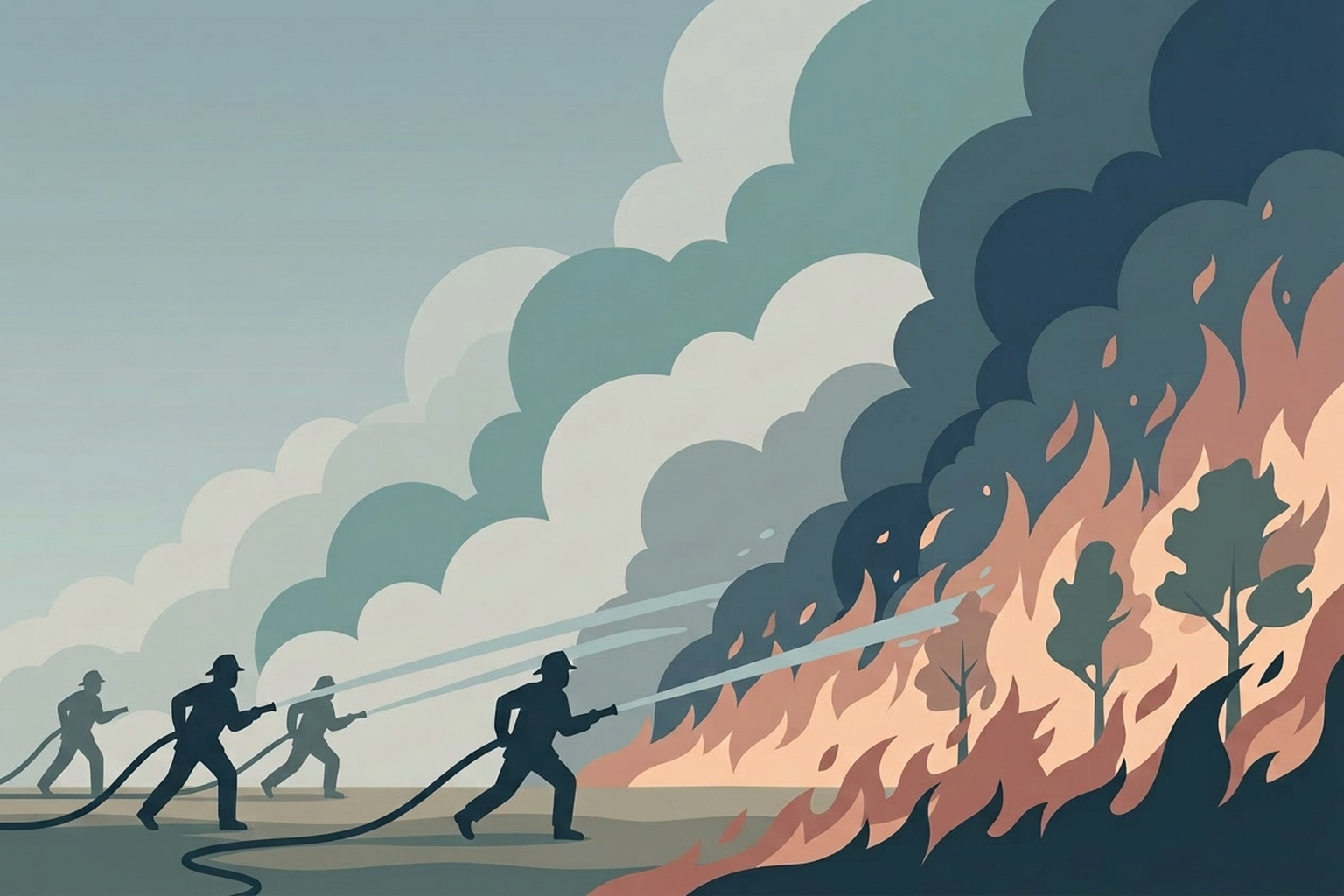
The Insurance Institute for Business & Home Safety (IBHS) is expanding its Wildfire Prepared Home program as wildfire risk spreads geographically across the United States, according to HousingWire's April 2026 report. The program — which launched in California in 2022 and has become a reference point for carriers pricing fire risk on high-value homes — is now being positioned as a national standard as fires increasingly threaten states east of the traditional Western fire belt.
For California luxury homeowners, the expansion is less about geography and more about leverage. A designation that is national in scope becomes harder for insurers to ignore, easier to underwrite against, and more durable as a long-term asset feature. What began as a California response to a statewide insurance crisis is now the working template for how wildfire-hardened homes get priced across the country.
What the IBHS Program Actually Measures
The IBHS Wildfire Prepared Home program operates in two tiers: the base Wildfire Prepared Home designation and the more stringent Wildfire Prepared Home Plus, which requires non-combustible wall construction, enclosed eaves, and additional structural measures. Both tiers are research-driven, built on IBHS's own laboratory ember and radiant-heat testing, rather than on component-by-component code minimums.
In California, the designation has already been absorbed into the regulatory stack. The California Department of Insurance's Safer from Wildfires framework requires carriers to recognize verified mitigation, and IBHS certification operates as an aggregate qualifying standard that short-circuits the measure-by-measure audit process. Mercury, USAA, Travelers, and Chubb have all signaled, in various forms, that IBHS-certified homes receive materially better treatment — with Mercury's wildfire premium reduction reaching up to 50% for qualifying properties, as HousingWire notes.
Why National Expansion Changes the California Math
There is a tendency to read a national program as a dilution of a state-level one. In this case, the opposite is true. When a certification exists only in California, carriers can argue it reflects a local regulatory accommodation. When the same certification is in force in Colorado, Arizona, Oregon, Texas, and the Southeast, it becomes the wildfire underwriting grammar — and homes without it become the exception that must be explained on every renewal.
For a luxury buyer commissioning a home in Malibu, Beverly Hills, or the Westside today, that shift matters in two ways. First, the specification conversation moves from optional to expected: architects and builders working in fire-exposed California geographies should now be designing to at least the Home Plus threshold by default, not by upgrade. Second, the resale narrative strengthens. A certification with national recognition is a clearer, more portable value signal than a state-specific one — especially for buyers relocating across markets, and for the out-of-state and international capital currently active in the $20M–$80M Westside band.
The quieter implication is for non-certified luxury inventory. As the designation becomes national baseline, wood-frame spec homes and legacy estates without mitigation data will face increasingly pointed diligence questions. The insurability premium attached to hardened construction is not disappearing — it is being formalized.
The Design Implication
Home Plus, in practice, pushes architecture toward non-combustible envelopes. That is a design decision before it is an insurance decision. Class A roofs, ember-resistant vents, enclosed eaves, non-combustible cladding, tempered glazing, and a five-foot Zone 0 around the structure are the architectural consequences of a program written by engineers who have burned test houses in a laboratory. They are also, not coincidentally, the same moves a thoughtful Mediterranean-influenced house in Southern California would make on climate and permanence grounds alone.
Designing toward IBHS, in other words, is not a compliance exercise. It is an alignment between how insurers price risk and how durable houses have always been built in hot, dry, fire-exposed landscapes.
Looking Ahead
The IBHS expansion will take time to reshape carrier behavior outside California, but inside the state it accelerates a trajectory already underway. Wildfire resilience is moving from a regional conversation to a national standard — and the luxury homes commissioned in 2026 will be the first cohort designed from day one against that standard rather than retrofitted into it.