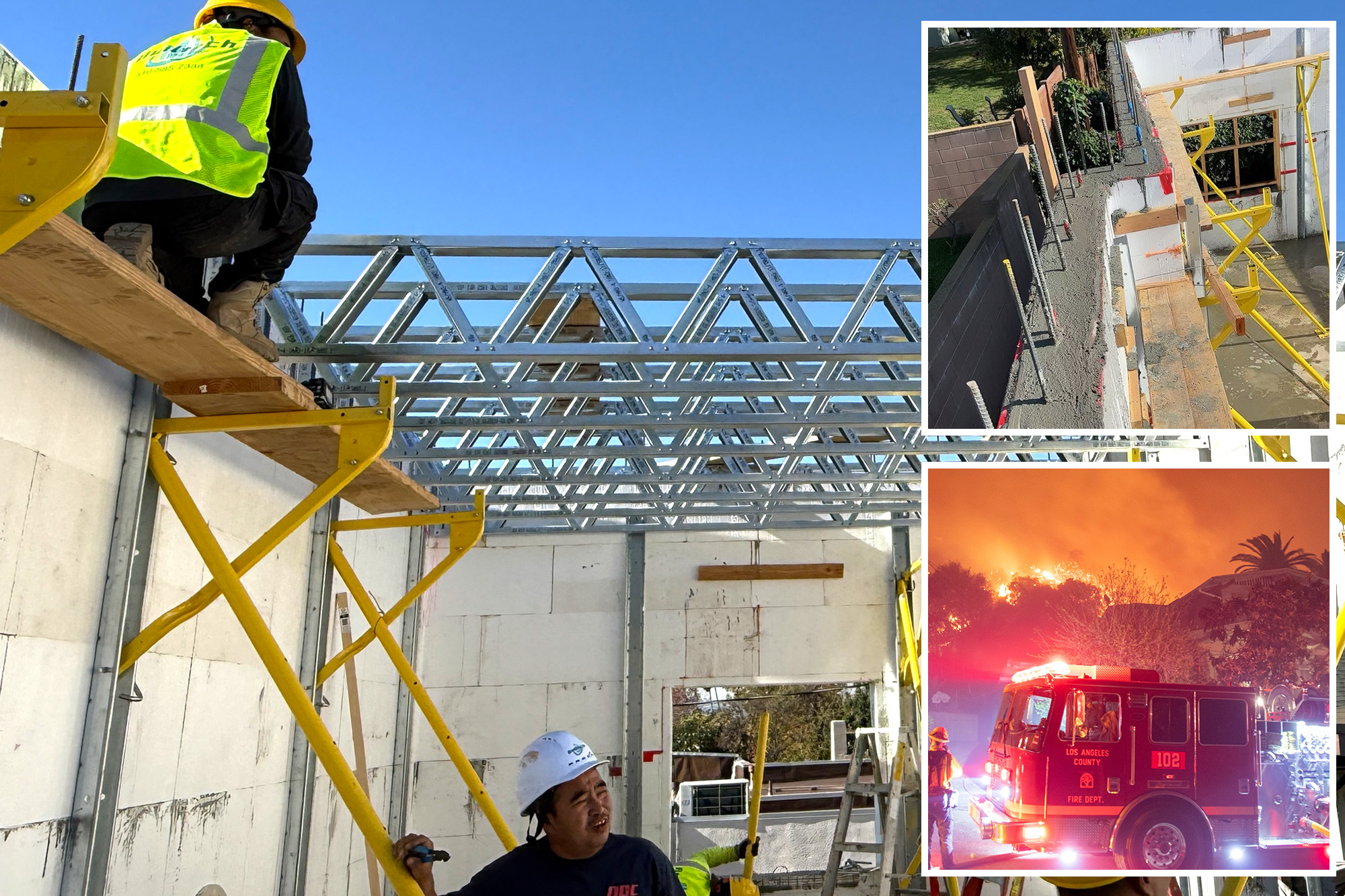
Los Angeles' first home explicitly marketed as fire-resistant was built for roughly $410,000 and is designed to withstand up to three hours of direct fire exposure, according to a widely circulated report from California Post on X, which pointed to coverage in the New York Post. The figures drew unusual attention for a real-estate story — more than 21,000 views — precisely because they upend an assumption: that building to resist fire is the preserve of large budgets.
The detail that matters is not the headline price but what the price implies. A three-hour fire-exposure rating is not achieved through coatings or sealants; it is a function of the building's core assembly — the walls, roof, and openings working as a non-combustible system.
The numbers behind the headline
According to the New York Post report, the home reached its three-hour rating through fire-resistant materials rather than expensive add-ons — a reminder that the performance gap between a combustible house and a non-combustible one is set during framing, not finishing.
$410,000 — reported build cost of LA's first fire-resistant home
3 hours — rated direct fire-exposure resistance
Up to 50% — potential wildfire premium reduction available to hardened homes in California
That last figure is where the construction decision meets the balance sheet. Under California's Safer from Wildfires framework, insurers are required to offer premium discounts for each mitigation measure a home adopts. A structure built non-combustible from the ground up does not chase those measures one by one — it satisfies them as a consequence of how it was built. In a state where non-renewals and FAIR Plan dependence have become routine, insurability has shifted from an afterthought to a design input.
What it means for the LA market
The significance of a $410,000 fire-resistant home is psychological as much as technical. For years, the Los Angeles conversation treated resilient construction as a luxury surcharge — something layered onto an already expensive build. This project reframes it as a baseline choice available across price points. The variable is method, not money.
For the high-end Westside and coastal markets — Malibu, Beverly Hills, Brentwood — the implication scales upward cleanly. If a modest budget can buy a three-hour rating, a luxury budget can buy a four-hour-plus envelope, full WUI-code native compliance, and the strongest insurability position the state allows. The premium for resilient construction is real, but it is increasingly the floor of a serious build rather than a discretionary upgrade.
A three-hour rating is not bought with finishes. It is decided by how the walls, roof, and openings are assembled.
The market signal, then, is straightforward: as carriers tighten underwriting and the 2026 WUI Code becomes mandatory for new builds in Fire Hazard Severity Zones, the homes that hold their value will be the ones whose resilience is structural rather than cosmetic.