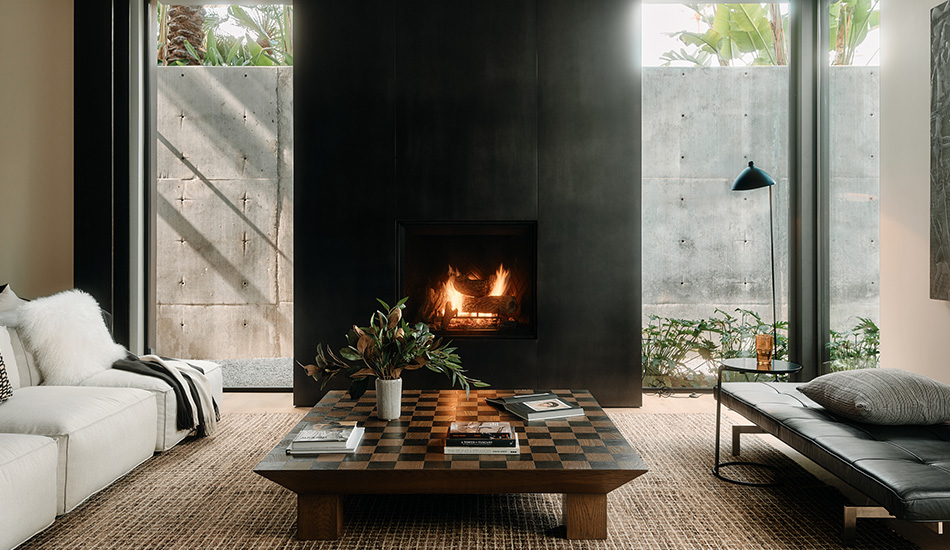
Olson Kundig's newly completed concrete residence in West Hollywood has arrived on the market at $5.75 million, according to 8899 Beverly's coverage of the debut. The house — designed by one of the most architecturally respected studios working in the United States — is notable less for its price than for its material. A ground-up concrete residence, presented as a luxury offering in a prime Westside submarket, is still an unusual event in Los Angeles, where the overwhelming default for single-family construction remains wood frame.
The listing is a useful data point for anyone tracking where the LA luxury market is heading. For more than a decade, concrete in Los Angeles has been read primarily as a cultural or institutional material — museums, galleries, a handful of celebrated modernist houses. Bringing it forward as a residential product, in a buyer-facing transaction at this price tier, is a different kind of proposition.
A material quietly moving from cultural to residential
Los Angeles has a long architectural memory of concrete — from Rudolph Schindler's tilt-slab Kings Road House in 1922 to Frank Lloyd Wright's textile-block houses of the 1920s. But in the decades since, the material largely retreated from the single-family market. What the 8899 Beverly report captures is a quiet reversal: architecturally ambitious concrete houses are returning to Westside inventory as discretionary luxury product, not as one-off experiments.
Several forces sit behind that shift. The first is insurability — California's underwriting environment has moved decisively toward non-combustible envelopes. The second is design fatigue with the wood-frame-and-stucco vocabulary that has dominated spec construction across Beverly Hills, Bel Air, and the Bird Streets for twenty years. The third is a generational change in the HNW buyer: clients who have traveled extensively in Europe, Japan, and Mexico, and who read exposed concrete as warmth and craft rather than as coldness.
Debut price for a ground-up concrete residence in West Hollywood
Geography of the signal — concrete as residential luxury, not institutional
What the signal means for the LA market
One listing does not make a trend, but it clarifies a direction that several forces were already pointing toward. When a studio with Olson Kundig's cultural weight underwrites a concrete house as a residential product on the Westside, it gives permission — to architects, to developers, to appraisers, and most importantly to comparable-sale data — to treat concrete construction as legitimate luxury inventory rather than an idiosyncratic outlier.
For the buyer commissioning new construction in Malibu, Beverly Hills, or Bel Air, the practical implication is that the appraisal and resale arguments for non-combustible construction have strengthened. For the architect, it widens the vocabulary of what "Californian" can mean beyond glass-walled mid-century revival. And for the insurance side of the transaction — the part of the market that now effectively underwrites what gets built — the alignment between design quality and risk classification is becoming harder to ignore.
Concrete is no longer the exception in the Westside luxury conversation. It is becoming one of the available languages.
Looking ahead
Expect more of this. The combination of architectural interest, underwriting pressure, and shifting client taste suggests that concrete residential work at the top of the LA market will move from rarity to recurring category over the next few years. The interesting question is no longer whether buyers will accept concrete — this listing answers that — but which architectural traditions will shape how it is used. The Japanese minimalist register is already established. The Italian villa register, with its courtyards and porticos, is still largely absent from the Westside. That gap is likely to close.