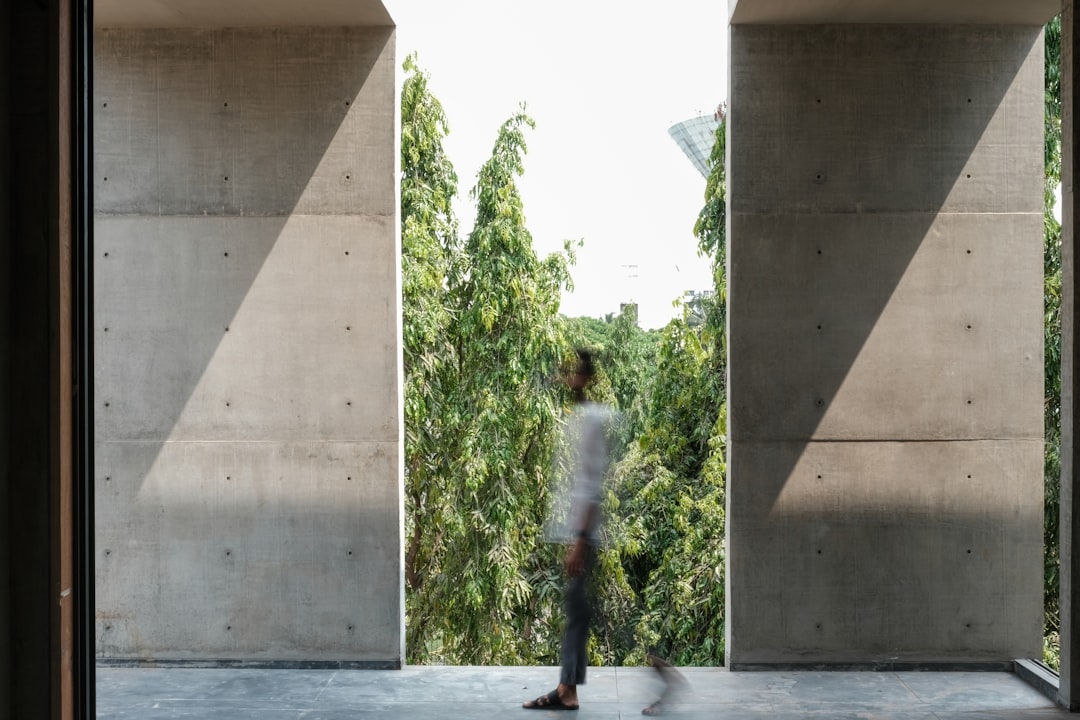
A Beverly Hills home built almost entirely from exposed poured concrete has sold for nearly $47 million, according to Mansion Global. The property — commissioned by the founder of eyewear brand Oakley and known for its industrial, machine-age aesthetic — is organized around a main structure of 96 poured-concrete columns with exposed tie holes, supplemented by an array of metal finishes and fixtures.
It is a rare data point in the Los Angeles luxury market: a top-tier sale in which the structural material is not concealed but is, in effect, the design language of the house.
A house where the structure is the finish
Per Mansion Global, the home's aesthetic leans on raw poured concrete left visibly imperfect — the tie holes from the formwork are not patched over but treated as part of the surface. That detail matters. In most luxury construction, concrete is a hidden skeleton wrapped in plaster, stone, or timber cladding. Here, the columns are the architecture, and the metalwork reads as ornament against a monolithic shell.
~$47M — sale price, Beverly Hills concrete home
96 — poured-concrete columns in the main structure
That the house achieved a near-$47M result is notable for a market where buyer taste usually rewards soft, neutral, mass-appeal interiors. A structure this committed to a single material — and this unwilling to disguise it — is closer to a piece of cultural architecture than a spec home.
What it signals for the LA market
The conventional wisdom in high-end Los Angeles resale is that idiosyncratic homes trade at a discount. This sale complicates that story. A concrete structure carried through to the finished surface is expensive to build well and effectively permanent — it cannot be value-engineered after the fact, and it ages differently than a wood frame behind a heavy facade.
In a market that usually pays for neutrality, a house sold on the honesty of its structure.
For buyers in fire-exposed Westside and canyon geographies, a non-combustible primary structure is also a substantive asset rather than a stylistic flourish — a point the market has been slow to price but is beginning to notice. The lesson of this sale is that material conviction, executed with precision, holds value at the very top of the market.
The relevant question for anyone building new in Los Angeles is no longer whether concrete belongs in a luxury home, but whether the design has the discipline to let the material be seen.