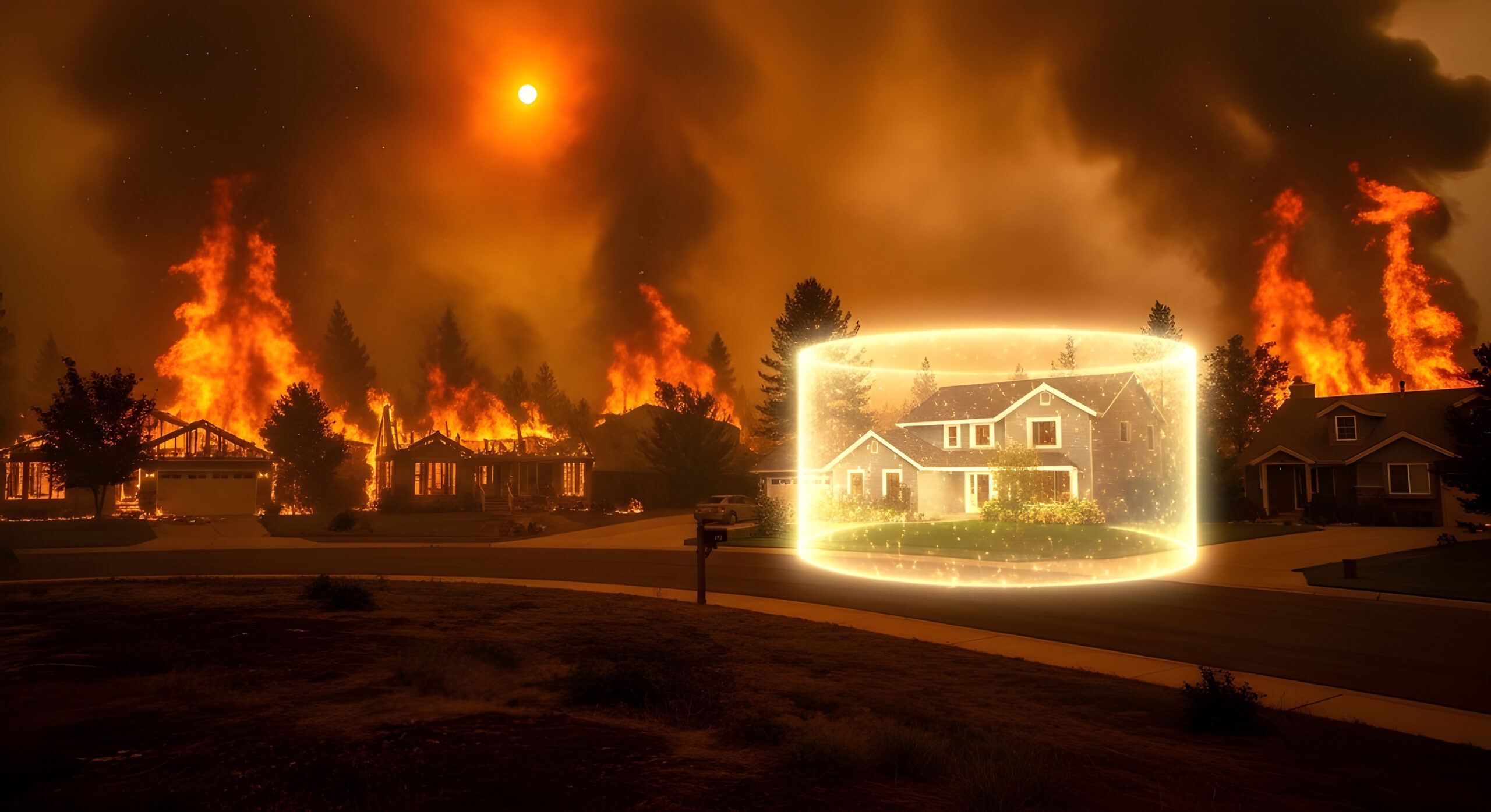
A California bill working its way through the legislature would require insurers to offer and renew homeowner coverage for residences built or hardened to recognized fire-safe construction standards, according to a feature in Insurance Journal. The proposal reframes the central problem of California's home-insurance market: instead of allowing carriers to non-renew properties in wildfire-exposed ZIP codes based on modeled risk alone, it would anchor eligibility to the physical characteristics of the house itself.
The shift is subtle but significant. Today, mitigation earns a discount. Under the proposed framework, mitigation — verified against defined standards — would begin to earn something closer to a right to coverage.
What the bill actually changes
California already has two mitigation frameworks in force. The Safer from Wildfires regulation, adopted by the Department of Insurance in 2022, defines 12 property-level and community-level measures — from Class A roofs and ember-resistant vents to a non-combustible five-foot zone around the structure — that insurers must recognize in pricing. Above that, the IBHS Wildfire Prepared Home designation, with a higher "Plus" tier, functions as the voluntary gold standard used by carriers including Mercury, USAA, Travelers and Chubb.
The Insurance Journal coverage notes that IBHS recently expanded the Wildfire Prepared Home designation, broadening how the standard can be applied across single-family properties. The legislative proposal builds on that architecture by linking these existing standards to the underwriting decision itself — not just the premium calculation.
Sources: California Department of Insurance, IBHS, Insurance Journal (March 2026).
Why this matters for the Los Angeles luxury market
For owners commissioning new homes in Malibu, Beverly Hills, Bel Air and the broader Westside, the bill clarifies a variable that has been uncomfortably discretionary. A property that today qualifies for a Mercury discount may still be declined at renewal; a property certified to IBHS Plus may still be placed on the FAIR Plan depending on ZIP-code exposure. Tying renewal obligations to verifiable construction standards narrows that discretion.
The practical consequence is a reordering of the design brief. When insurability is governed by a bundle of documented attributes — non-combustible envelope, ember-resistant vents, Class A roof assembly, defensible-space geometry — the architect and builder are effectively working inside an insurance specification as well as a zoning code. Projects designed around those attributes from the first sketch will move through underwriting on a different track than projects that attempt to bolt mitigation onto a conventional wood-frame shell.
That is a meaningful advantage in a market where carrier capacity in Tier 1 wildfire geographies remains constrained and where the FAIR Plan, by design, is a placeholder rather than a destination.
Under the proposed framework, mitigation would begin to earn something closer to a right to coverage — not just a discount.
The legislative signal
Whether this specific bill passes in its current form is less important than the direction it confirms. Sacramento is steadily converting mitigation from a voluntary market signal into a regulatory instrument. The 2026 California WUI Code did this for new construction; Safer from Wildfires did it for pricing; this bill extends the same logic to availability. For buyers planning a 50- to 100-year hold in a fire-exposed luxury geography, the question is no longer whether the insurable-construction standard will harden further, but how quickly.