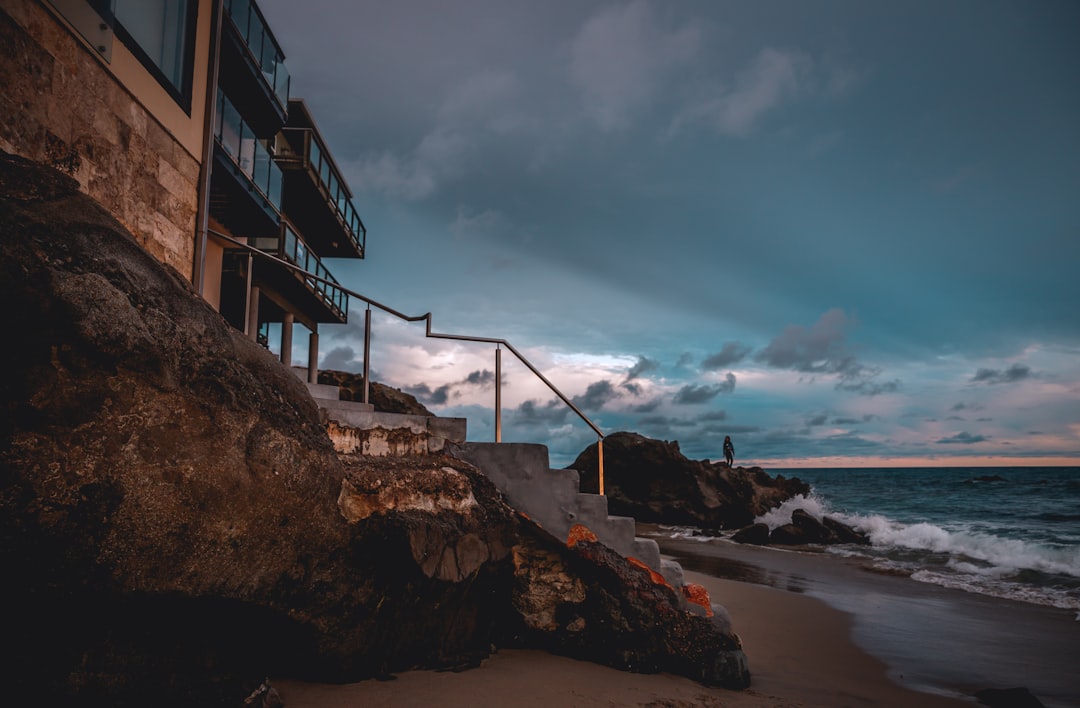
A video tour of a $44 million all-concrete mansion in Malibu, circulated on X in early May 2026 by @JeremyWilsiuwe, has put a spotlight on a quiet shift in California's ultra-prime coastal market: monolithic concrete is no longer a structural footnote. It is being sold as the defining feature of the home.
The listing — pitched on the strength of its concrete construction and ocean views — is one data point, but it sits inside a broader pattern. Across the Westside and the Malibu coast, concrete has migrated from the engineering sheets to the headline of the marketing copy. Buyers at the $20M+ band are reading wall sections, not just floor plans.
Why concrete is now a marketing lead
Two forces are converging on the California coast. The first is regulatory: the 2026 California WUI Code (Title 24, Part 7) is the first full year of mandatory wildland-urban interface compliance for new construction in Fire Hazard Severity Zones, raising the floor on what "new" means in coastal Malibu. The second is insurance: admitted carriers are recalibrating around verified mitigation, and homes built with non-combustible structural envelopes sit on a different side of the underwriting line than homes that achieve fire resistance through cladding alone.
The result is that the conversation around a coastal listing has changed. "All concrete" used to be a curiosity — a brutalist statement, or a quiet engineering choice for a hillside cantilever. In 2026 it functions as shorthand for a different category of building: one whose envelope, longevity claim, and insurability narrative are all delivered by the same material.
What the $44M listing tells the market: the cost premium of structural concrete is now visible — and being priced — at the top of the Malibu band. The material is the asset, not a hidden component of it.
The Malibu band and what it is signaling
Malibu's ultra-prime tier — roughly $20M and above for coastal lots — is where California's broader insurability question gets stress-tested. These are the homes whose carriers are scarcest, whose replacement costs are highest, and whose buyers are most able to make a long-horizon decision on construction type. When a listing at this band leads with "all concrete," the seller is making a calculated bet that buyers will pay for the structural decision rather than discount it as overbuilt.
The same logic is visible in the new-construction pipeline elsewhere in the L.A. luxury market, where reinforced-concrete spec houses on the Westside have begun debuting at premium price points. The signal is consistent: coastal and hillside ultra-prime buyers are treating material permanence as a value driver, not a niche taste.
Why this is a market read, not a one-off
A single $44M listing does not redefine a market. But it does what listings at the top of the band always do — it tests a thesis publicly. The thesis here is that, in coastal California in 2026, the buyer who is going to write the largest checks wants the wall section to be the answer, not the question. The monolithic concrete envelope is being marketed because the seller believes it is the most defensible part of the value story under both fire risk and insurance scrutiny. Whether the home trades at ask, above, or below will be a useful read on how strongly that thesis is now priced in.
What to watch next
The next twelve months will reveal whether all-concrete construction stays a headline at the very top of the Malibu market or whether it migrates down into the $10M–$20M band, where the larger volume of new luxury construction sits. The 2026 WUI Code, the recalibration of admitted carriers around verified mitigation, and the visible willingness of high-end buyers to read material specs all push in the same direction. The listing is one of the clearer leading indicators we have seen this spring.